
Advisory on Token Issuance under the MiCA Regulation
Advisory on Token Issuance under the MiCA Regulation



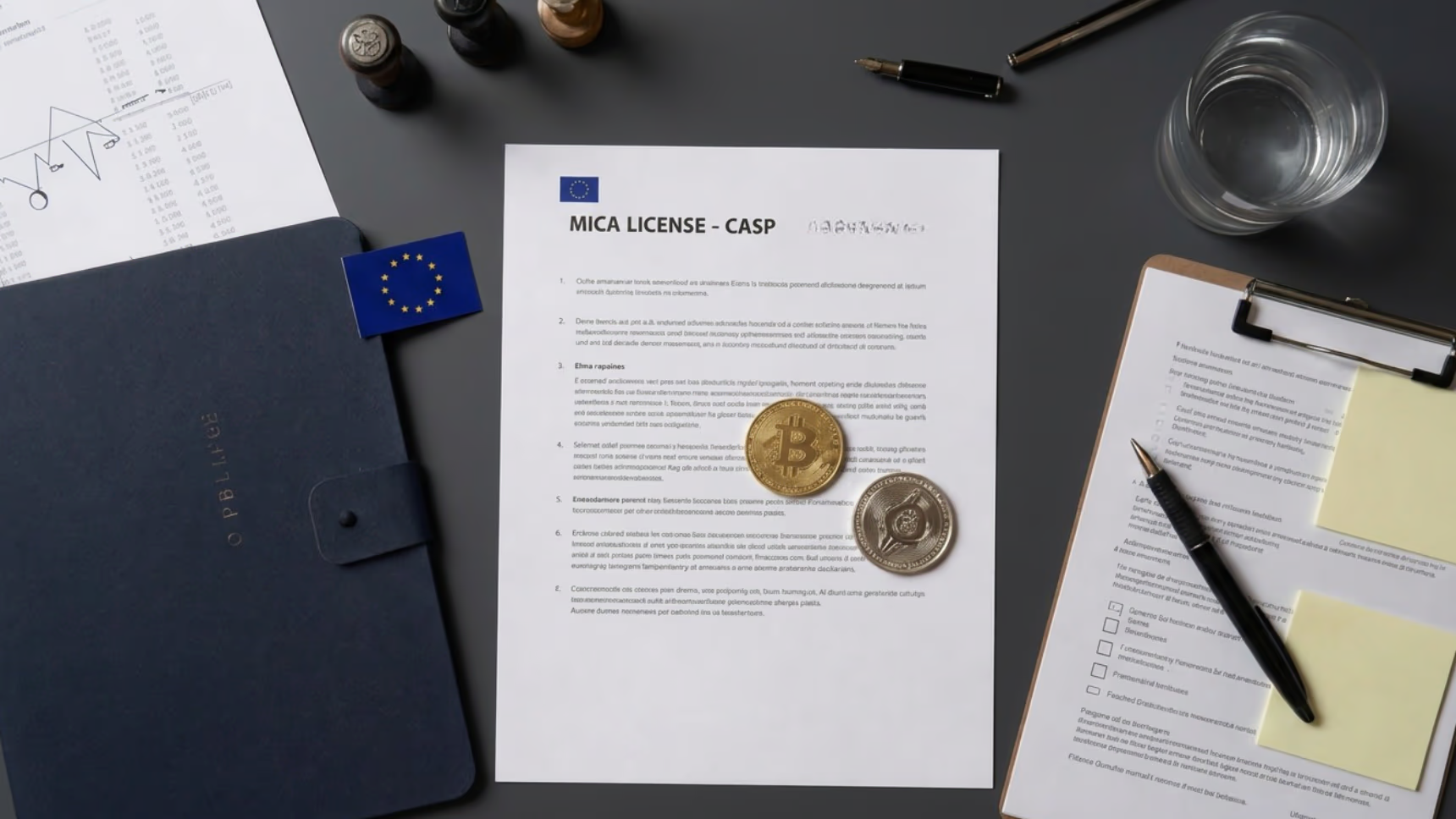




MiCA-Compliant Token Issuance in Europe
Token issuance in Europe can no longer be treated as a gray area or as a purely technical decision. With the entry into force of the MiCA Regulation, any project seeking to launch a token in the European Union must address a fundamental question: whether it can legally issue the token and what exactly European regulations require.
MiCA establishes uniform rules for issuers of crypto-assets and providers of related services, particularly when these assets were not regulated by other European Union financial regulations.
Token issuance is a legal, regulatory, and strategic decision. It affects the project’s viability, access to the European market, investor relations, financial inclusion, the issuer’s liability, and business continuity.
The key question is not just whether you can issue a token, but whether you can do so in compliance with MiCA without compromising the project’s future growth.
Therefore, before launching a token in Europe, it is essential to analyze its nature, the associated business model, and the regulatory risks as part of a comprehensive MiCA crypto regulation.
What is considered a token issuance under MiCA?
From the perspective of MiCA, the issuance of tokens is not limited to the technical act of creating a crypto-asset on a blockchain. The Regulation pays particular attention to the public offering and admission to trading of crypto-assets.
An offer to the public may exist when a communication is directed at individuals in the European Union that contains sufficient information about the terms of the offer and the cryptoassets being offered to enable them to decide whether to acquire them.
This may include websites, digital campaigns, sales presentations, investor documents, online communities, or any other mechanism that makes the token available to the European market.
Many projects believe they are simply “launching a token,” when in reality they are conducting a regulated offering. Not all token offerings are subject to MiCA, but any exclusion must be legally justified and cannot be based solely on the project’s marketing label.
Types of tokens regulated by MiCA
One of the central elements of the Regulation is the classification of cryptoassets.
Utility tokens are designed to provide digital access to an existing or planned good or service. Although they are generally perceived as less complex from a regulatory standpoint, they may give rise to obligations when offered to the public in the European Union.
Asset-Referenced Tokens (ARTs) are cryptoassets whose value is intended to remain stable by reference to one or more assets, such as fiat currencies, commodities, or other cryptoassets. They are subject to stricter regulations due to their potential financial impact.
Electronic Money Tokens (EMT) refer to a single fiat currency and are typically used as a means of payment. Their regulatory treatment is similar to that of electronic money institutions and requires special caution.
Classifying a token correctly is not a theoretical exercise. A mistake could force a redesign of the legal structure, prevent access to banking services, or lead to regulatory penalties.
What does MiCA not regulate?
MiCA does not cover all digital assets or all tokenized structures.
Certain financial instruments that are already subject to securities market regulations—such as stocks, bonds, or other securities regulated under the traditional financial framework—are excluded.
Certain truly unique and non-fungible NFTs may also be excluded. However, when they are issued in series, fractionalized, or have homogeneous characteristics, the exclusion may no longer apply.
Digital currencies issued by central banks are also not regulated under MiCA, but rather under their own specific frameworks.
Determining whether a project falls outside the scope of MiCA does not depend on the token’s name, but rather on its structure, economic function, method of distribution, and target audience.
Who needs authorization to issue tokens?
The obligation to comply with MiCA does not apply only to large crypto companies.
Web3 startups, companies that tokenize services or assets, international projects targeting European users, and companies already in operation that are expanding their offerings may be subject to the regulations.
MiCA does not distinguish solely based on size, but also on activity, the nature of the offering, and the impact on the market.
Even when no prior formal authorization is required, the issuance may entail obligations regarding disclosure, transparency, liability to purchasers, and ongoing compliance.
In addition, a token offering may be linked to other regulated services. If the project also holds assets in custody, executes orders, operates a platform, or provides services to third parties, it may be necessary to assess whether CASP license.
Requirements for Issuing Tokens in Europe
Issuing tokens in compliance with MiCA requires much more than simply developing a smart contract or deploying a digital asset.
Essential elements include the classification of the token, identification of the issuer, preparation of a regulated white paper, definition of responsibilities, an appropriate corporate structure, governance, risk management, and, where applicable, compliance with anti-money laundering regulations.
The issuer must demonstrate that it has sufficient resources, organizational structure, and controls to meet the obligations arising from the issuance.
The CNMV notes that MiCA took effect on December 30, 2024, and that its objective is to establish a common framework to regulate the issuance, offering, and trading of cryptoassets and to protect investors.
The MiCA Regulatory White Paper
The MiCA white paper is one of the most sensitive documents in the offering.
It must provide clear, accurate, and complete information about the project, the issuer, the cryptoasset, and the associated risks. It is not merely a marketing document or a presentation intended to attract investment.
Unlike traditional white papers in the crypto ecosystem, a regulated white paper serves a legal purpose. It must describe the rights and obligations associated with the token, the risks, the technology, the use of funds, and the terms of the offering.
The information must be consistent, understandable, and not misleading. The issuer assumes responsibility for its content, which makes the wording a critical factor from both a legal and reputational standpoint.
Reusing a “classic crypto” white paper without adapting it to MiCA is one of the most common mistakes and can result in liability to regulators and investors.
Professional, personalised service throughout Spain.
The IN DIEM Law Firm has offices in Madrid, Seville, Málaga, and Las Palmas de Gran Canaria… as well as in other cities and towns. IN DIEM provides legal services throughout Spain and internationally, and offers online services. Every case is very important to us, and we handle each one with care and diligence.
Experience: Judges, Prosecutors, State Attorneys.
Abogados IN DIEM is a law firm staffed by professionals with extensive prior experience as judges, prosecutors, state attorneys, and university professors… who provide the peace of mind and assurance that come with having the best team—one that is competitive and highly qualified to achieve your goals and meet your needs.
Common Mistakes When Issuing Tokens
Many projects are forced to be redesigned because of mistakes made before launch.
Among the most common mistakes are confusing a utility token with an asset subject to stricter regulations, launching the token without prior regulatory review, failing to anticipate the banking implications of the issuance, or ignoring subsequent obligations.
It is also commonly believed that compliance ends with the issuance. In reality, the issuance usually marks the beginning of an ongoing regulatory relationship.
These errors can result in bank freezes, regulatory warnings, liability to investors, or in response to MiCA inspections.
Token Issuance and the European Passport
A properly structured issuance under MiCA can facilitate access to the European market in a harmonized manner.
The common framework reduces fragmentation among Member States and allows certain projects to enter the European market with greater legal certainty.
However, the European passport does not eliminate all obligations. The issuer must ensure consistency between what is declared, the actual implementation of the project, and subsequent compliance.
Therefore, the issuance must be coordinated with systems for ongoing MiCA compliance systems that allow documentation and controls to be adapted to the project’s actual progress.
How does IN DIEM support you in your token issuance?
Our approach is based on a clear idea: not all tokens should be issued, and not all projects are viable as currently proposed.
We support each project from both a legal and strategic perspective, analyzing the nature of the token, the business model, the issuance structure, regulatory risks, banking implications, and subsequent obligations.
We work in coordination with technical specialists when necessary to integrate regulatory analysis with the project’s blockchain architecture, thereby strengthening the soundness of the assessment and the white paper.
The goal is not simply to issue a token, but to do so in a way that allows the project to grow in Europe with legal certainty, credibility among investors, and a genuine ability to comply.
Request a MiCA Assessment
If you are considering launching a token in Europe or already have a project underway, the first step should not be to issue the token, but rather to assess whether the issuance is feasible under MiCA.
Request a MiCA Assessment to evaluate the type of token, applicable requirements, potential exemptions, regulatory risks, and the most appropriate strategy for issuing tokens in Europe.
At IN DIEM, we support you with legal, regulatory, and business expertise as part of our specialized service for cryptocurrency attorneys.
Give us a call.
Immediate attention & resolution. In Diem team.

Call us—we'll be happy to assist you… IN DIEM Emergency Service
IN DIEM Abogados makes available to its clients an urgent assistance service, operating 24 hours a day, for emergency situations, whether in criminal matters, contracting, litigation, or family matters.
In-person service
Our team of lawyers will see you in person in: Málaga, Madrid, Seville, Las Palmas de Gran Canaria, Huelva, Jerez, Cádiz; as well as Tomares, Mairena del Alcor, Mairena del Aljarafe, Coria del Río, Dos Hermanas, Estepona, and Marbella, among others.
Excellence
Extensive experience as Prosecutors, State Attorneys, Judges, University Lecturers, or high-level Trade Union Representatives, providing you with peace of mind and confidence.
Online service
IN DIEM provides assistance wherever you need it. National and international assistance. We assist via videoconference (through available applications such as Skype, GoToMeeting, or WhatsApp) and by telephone.
24-Hour Lawyers
Immediate legal assistance, 24 hours a day. Our team of lawyers is available to advise you and support you in any situation, providing fast, professional, and confidential assistance by phone, video call, or in person.
Trends, Legal News, and Expertise



Frequently Asked Questions International Legal
Answers to frequently asked questions about international legal services, cross-border operations, corporate law, and global legal advisory.
What does it mean to issue tokens in accordance with MiCA?
It refers to launching, offering to the public, or admitting cryptoassets to trading within the European market in compliance with the obligations set forth in the MiCA Regulation. This may include token classification, preparing the white paper, disclosure requirements, issuer liability, and ongoing regulatory compliance.
Is every token issuance subject to MiCA?
Not necessarily. MiCA provides for exclusions and circumstances in which the Regulation may not apply. However, the applicability of an exclusion must be analyzed from a legal perspective based on the nature of the token, its economic function, the manner of its offering, and the target audience.
What is a public offering of cryptoassets?
It is a communication directed at individuals in the European Union that contains sufficient information about the terms of the offering and the cryptoassets being offered to enable them to decide whether to purchase them. It may be provided through a website, advertising campaigns, marketing materials, or presentations to investors.
What types of tokens does MiCA regulate?
MiCA distinguishes, among other things, between cryptoassets other than ARTs and EMTs, asset-referenced tokens (ARTs), and electronic money tokens (EMTs). This classification determines the applicable obligations and can directly affect the viability of the project.
What is a MiCA white paper?
It is a regulated document that must provide clear, accurate, and non-misleading information about the project, the issuer, the cryptoasset, its risks, the associated rights, the technology used, and the intended use of the funds. It is not merely a marketing document.
Can I launch a token from outside the EU?
It depends. If the offering is directed at users or investors in the European Union, MiCA may apply even if the issuing company is incorporated outside the EU. The economic reality of the offering takes precedence over the entity’s formal location.
What happens if I misclassify my token?
Incorrect classification can lead to regulatory violations, difficulties in accessing banking services, penalties, liability to investors, and the need to redesign the project. Therefore, classification must be completed before launch.
Is my utility token always exempt from strict requirements?
No. A utility token may be subject to MiCA obligations if it is offered to the public or admitted to trading. The commercial designation of “utility token” does not, by itself, determine the applicable legal regime.
Does issuing tokens require a CASP license?
Not always. Issuing tokens and providing services as a crypto-asset service provider (CASP) are distinct activities, although they may be related. In many cases, it is necessary to analyze both the issuance and whether any associated activity requires a CASP license.
Why is it a good idea to conduct a MiCA assessment before issuing securities?
Because it allows you to analyze the nature of the token, determine whether a public offering exists, identify applicable obligations, verify potential exemptions, prepare the necessary documentation, and identify regulatory risks before committing to investment, marketing, or fundraising.
Is your token ready for the European market?
Token classification, the white paper, the issuer’s obligations, and regulatory strategy are all aspects that must be analyzed before going to market. We help you structure the offering from both a legal and business perspective.
Legal Directors
, the In Diem Team.



Do you need help and a free initial consultation?
Schedule an initial consultation. In 60 minutes, we’ll provide you with an honest assessment, the available options, and the next steps.
Contact Us
Do you have any questions or comments?
Fill out the form below, and we’ll get back to you as soon as possible.
Call us at (+34) 954 270 522 or fill out our form, and we will get in touch with you.