
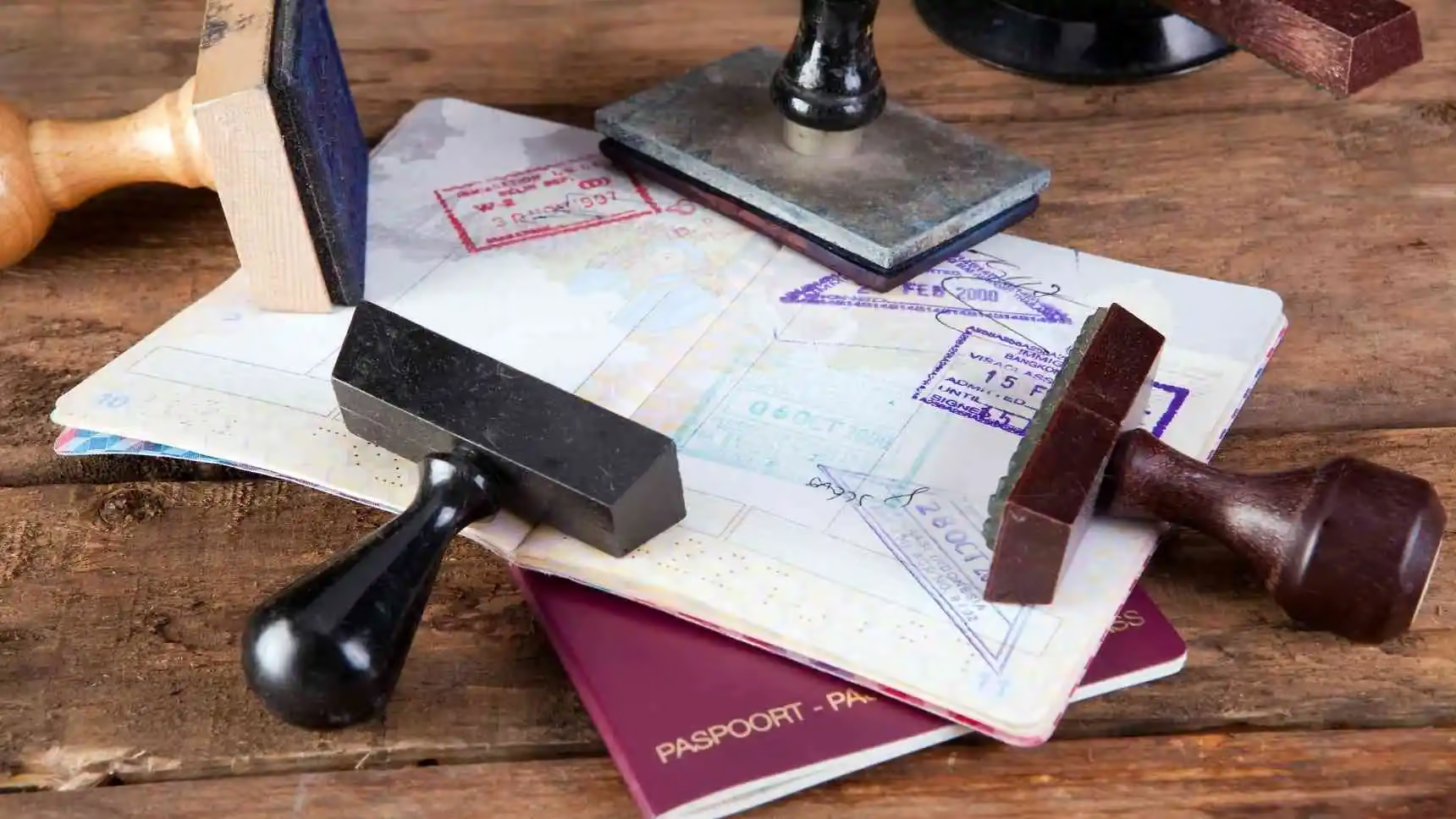
Currently, we operate in a world where international transactions are commonplace, resulting in a continuous exchange of official documentation. However, a public document issued and/or validated by the authority of one country, while fully legitimate there, may require certain formalities to be admitted in another and to retain its value as an official document. Thus, for example, when we have an employment contract, a marriage certificate, or an academic degree issued abroad, these documents need to be evaluated in the receiving country to verify their authenticity.
Therefore, in this article, we want to provide you with the guiding keys to understanding the legalization of foreign documents in Spain and vice versa, although for each specific case, it is advisable to seek specialized advice.
What does the legalization of documents involve?
The legalization of foreign documents is an administrative procedure that serves to attest to the authenticity of the signatures on said public document, granting it validity in the receiving country. In other words, the document needs to be examined to verify that it has indeed been issued by a competent foreign authority so that it can exert all its legal effects in the State in question.
Generally, all foreign public documents need to be legalized to be valid in Spain, just as all Spanish public documents must undergo the same procedure in the corresponding country to be valid abroad.
How do I apply?
Foreign documents can be legalized in Spain through two channels:
- Legalization by Spanish Embassies or Consulates of documents issued by foreign authorities abroad.
- Legalization in Spain through the Legalization Service of the Ministry of Foreign Affairs, European Union and Cooperation of documents issued by foreign Consulates and Embassies accredited in Spain.
Legalization carried out by the Ministry’s Legalization Service will be free of charge, while legalizations via Embassies or Consulates will involve the payment of a fee.
On the other hand, for Spanish documents to be legalized in other States, the type of document and the issuing body must be taken into account to complete all corresponding procedures before their legalization by the foreign authority.
Agreement between Countries
As the transit of documents between countries becomes increasingly frequent, some States have chosen to sign international agreements to facilitate these bureaucratic procedures for their citizens. Under these agreements, the legalization procedure is significantly simplified in certain cases.
Among these agreements, Regulation (EU) 2016/1191 of the European Parliament and of the Council of 6 July 2016 has been applicable to all European Union Member States since February 16, 2019, facilitating the free movement of citizens by simplifying the requirements for presenting certain public documents in the European Union.
This Regulation exempts certain public documents requested from the authorities of a Member State from legalization or similar formalities when they are intended to be presented before the authorities of another European Union member. It is important to note that this exemption does not apply to all public documents, such as those relating to civil status issued on the basis of the relevant Conventions of the International Commission on Civil Status.
Furthermore, the Regulation introduces the possibility for citizens to request a multilingual standard form for documents exempt from the procedure, with a translation into the language of the Member State where it is to be presented. However, this multilingual form has no independent legal value and must always be accompanied by the public document it translates.
Here you can view the list of EU member states.
On the other hand, at an extra-European level, we also find the Hague Convention No. XII of 5 October 1961 Abolishing the Requirement of Legalisation for Foreign Public Documents.
Among the signatory countries of the aforementioned Convention, the legalization procedure will not be necessary, although mutual recognition of documents requires them to have a seal or apostille, commonly known as the “Hague Apostille.” However, as with the EU Regulation, there are certain documents that are not exempt from legalization, in particular, documents issued by diplomatic or consular agents and administrative documents directly related to a commercial or customs operation. If needed, you can find information about the apostille process at the Ministry of Justice.
Here you can find the list of countries that are signatories to Hague Convention No. XII.
- Other Conventions
In addition to those mentioned above, Spain is also a signatory to other conventions aimed at simplifying legalization procedures, namely the Athens Convention, the Vienna Convention, and the London Convention
How can we help you?
Our expert lawyers are familiar with judicial and notarial entities to offer an efficient service in processing requests and validating documents, both for Spanish clients wishing to legalize and apostille documents abroad and for foreigners needing to do so in Spain.
Likewise, we collaborate with various firms worldwide to provide accelerated and functional management of document request and validation procedures.
Author: Irene Martín Salguero
Preguntas frecuentes sobre legalización de documentos extranjeros
¿Qué es la legalización de documentos extranjeros?
Es un procedimiento administrativo que permite acreditar la autenticidad de la firma, cargo o autoridad que ha emitido un documento público, para que pueda desplegar efectos legales en otro país.
¿Todos los documentos extranjeros deben legalizarse para ser válidos en España?
Con carácter general, los documentos públicos extranjeros pueden requerir legalización o apostilla para ser admitidos en España. No obstante, existen excepciones derivadas de reglamentos europeos o convenios internacionales aplicables según el país y el tipo de documento.
¿Qué diferencia hay entre legalización y apostilla de La Haya?
La legalización es un procedimiento más amplio de validación de documentos. La apostilla de La Haya simplifica ese trámite entre países firmantes del Convenio de La Haya, sustituyendo la legalización ordinaria por un sello o certificación específica.
¿Cuándo puede utilizarse la apostilla de La Haya?
Puede utilizarse cuando el documento público procede de un país firmante del Convenio de La Haya y va a presentarse en otro Estado también firmante. Debe comprobarse siempre si el documento concreto está incluido dentro del ámbito del convenio.
¿Qué documentos pueden necesitar legalización o apostilla?
Pueden requerir legalización o apostilla documentos como certificados de nacimiento, matrimonio o antecedentes penales, títulos académicos, poderes notariales, documentos judiciales, certificados administrativos o documentos emitidos por autoridades públicas.
¿Qué ocurre con los documentos dentro de la Unión Europea?
En determinados casos, el Reglamento (UE) 2016/1191 simplifica la presentación de algunos documentos públicos entre Estados miembros de la Unión Europea, eliminando la exigencia de legalización o trámite equivalente para ciertos documentos.
¿El impreso estándar multilingüe sustituye al documento original?
No. El impreso estándar multilingüe facilita la comprensión del documento en otro Estado miembro, pero no tiene valor jurídico autónomo. Debe acompañar siempre al documento público al que se refiere.
¿Dónde se legalizan documentos extranjeros para usarlos en España?
Según el caso, pueden legalizarse ante Embajadas o Consulados de España en el extranjero, o a través del Servicio de Legalizaciones del Ministerio de Asuntos Exteriores, Unión Europea y Cooperación cuando proceda.
¿La legalización implica que el contenido del documento sea correcto?
No necesariamente. La legalización acredita la autenticidad formal de la firma o autoridad que expide el documento, pero no supone una revisión completa del contenido material ni garantiza por sí sola que el documento sea suficiente para el trámite concreto.
International Law Lawyers. Experts in Legalization of foreign documents and vice versa | In Diem: Malaga, Marbella, Seville, Madrid, Las Palmas de Gran Canaria, Almeria, Huelva…
IN DIEM Lawyers has extensive experience and a high degree of specialization in the area of International Law, related to the legalization of foreign documents for validation in Spain or vice versa, offering its clients the necessary advice at all times.
Abogados IN DIEM has a team with experience in roles such as magistrate, state attorney, prosecutor, and university professor, which will give you peace of mind and confidence, knowing you have the best team—one that is competitive and highly qualified to achieve your goals and meet your needs.
We are at your disposal for whatever you need. You can reach us through the IN DIEM Lawyers Telephone (+34) 901 900 071. In cases of Emergency, you have us at the 24-Hour Emergency Lawyers Telephone IN DIEM: (+34) 610 667 452.
Did you know that Abogados IN DIEM offers online services and expedited services?
We offer our clients the option of receiving assistance via video call or videoconference, as well as by phone, depending on their preference, so that the assistance is as personalized as possible, provided immediately, and without the need to travel. This service is complemented by communication via email, which facilitates the review and submission of documentation.
We also offer urgent and 24-hour services to our companies, handling both domestic and international contracting operations.
Anything else about IN DIEM Lawyers? Here’s a short presentation video…
To acknowledge some of you, here’s this link.
You can find us in Seville, Madrid, Las Palmas de Gran Canaria, Málaga, Huelva, Punta Umbría, Tomares, Coria del Río, Dos Hermanas, Mairena del Alcor, Estepona, Marbella, and Mairena del Aljarafe. We look forward to serving you.