
What is my company worth?
What is my company worth?


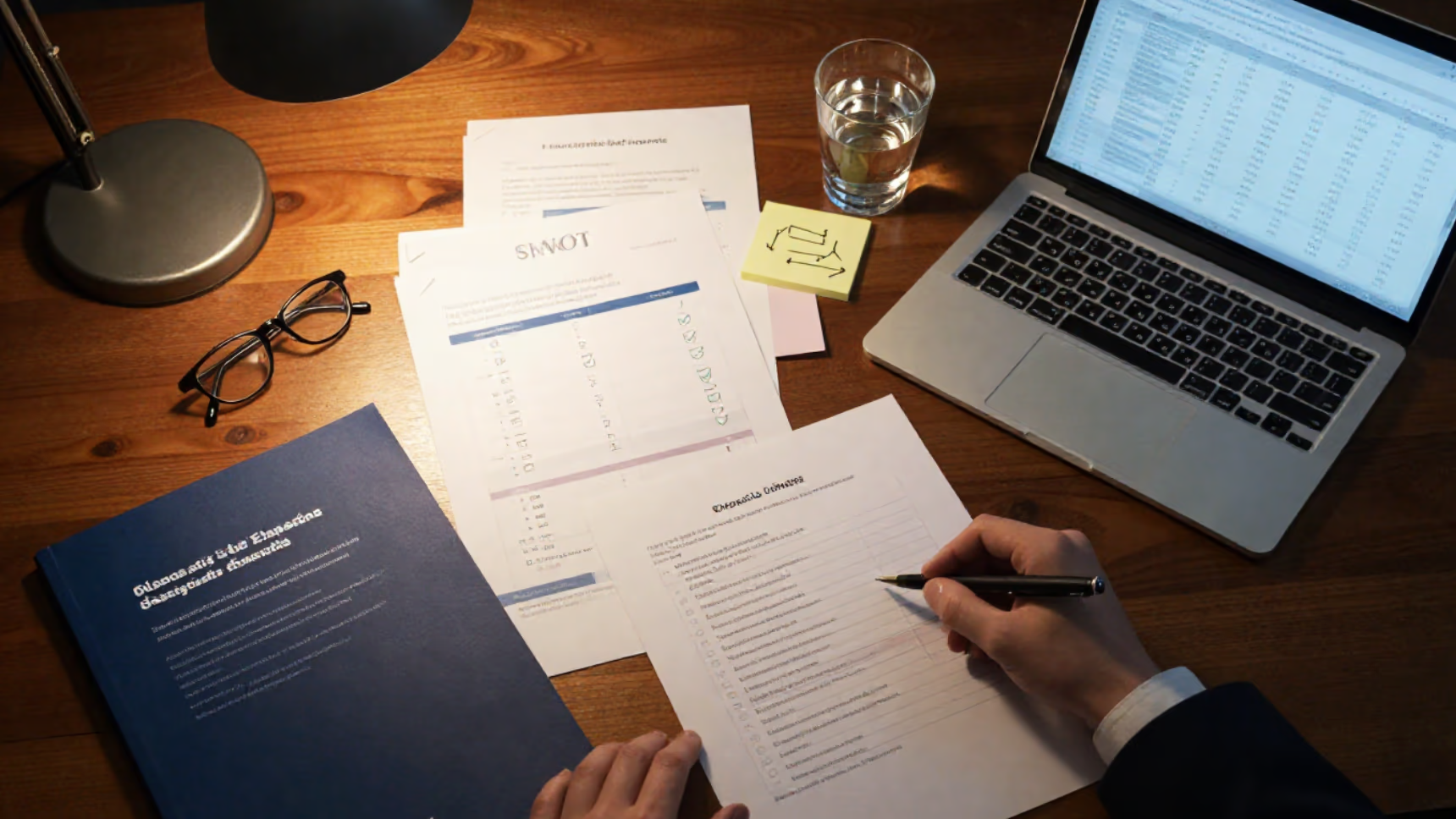







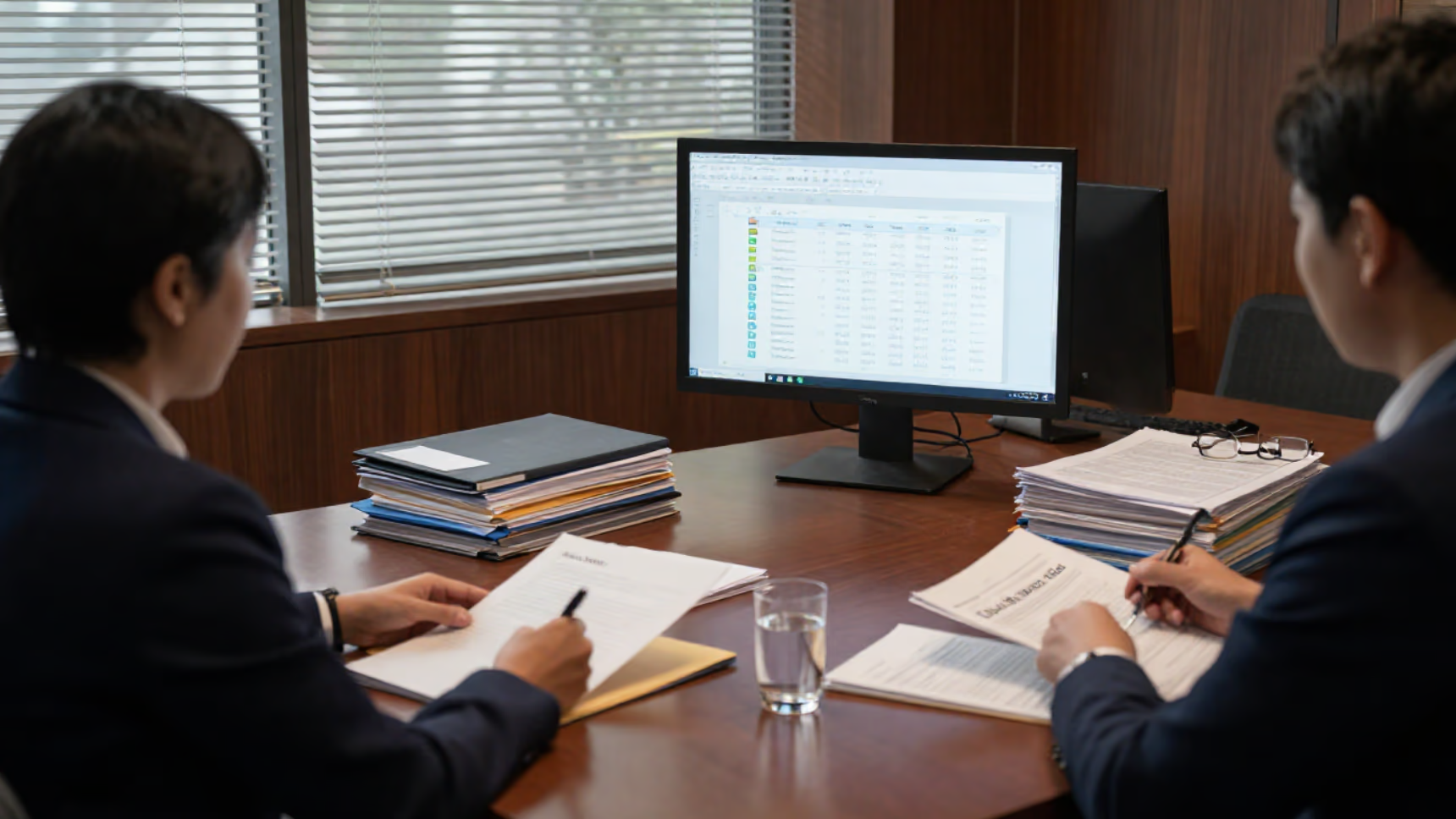
Business Valuation: How Much Is My Business Worth?
Preliminary Valuation of Companies Before Initiating a Sale Process
One of the first questions business owners ask themselves when considering a corporate transaction is how much their company is actually worth. Knowing the approximate value of a company is essential for making strategic decisions related to a potential sale, bringing in investors, or a shareholder restructuring.
Valuation does not depend solely on financial results. Factors such as legal structure, the quality of internal organization, existing risks, competitive positioning, and expectations for future growth directly influence the perception of value.
Therefore, before beginning a negotiation process, it is advisable to conduct a preliminary analysis to estimate a reasonable range of value and identify the factors that could increase or decrease it.
Value from the buyer’s perspective
Buyers analyze a company from a very different perspective than that of the business owner who is selling it.
While the owner typically takes into account emotional factors, years of effort, personal sacrifices, or the accumulated equity, the buyer focuses exclusively on objective criteria.
Their analysis is based on the company’s ability to generate future profits, the stability of its revenue, the risks associated with its business, growth opportunities, and the expected return on investment.
Understanding this difference is essential to properly prepare for a future sale and present the company in a way that highlights the elements that truly create value for the market.
How is a company’s value calculated?
There are various valuation methods, and in practice, buyers often use several of them simultaneously to arrive at a reasonable estimate.
Valuation Based on EBITDA Multiples
It is one of the most commonly used methods in business acquisitions and sales.
It involves applying a multiple to the company’s EBITDA, with that multiple varying based on factors such as the industry, size, revenue stability, and growth prospects.
Valuation Using Market Multiples
This method analyzes similar transactions that have taken place recently and uses comparable companies as a benchmark.
It allows you to see what buyers are paying for comparable companies in the same market.
Cash Flow Discounting Valuation
The DCF method projects future cash flows and discounts them to their present value using a rate that reflects the investment’s risk.
It is used primarily by investment funds and professional buyers when reliable projections are available.
Asset-Based Valuation
It focuses on the value of the company’s assets, net of its liabilities.
It is particularly useful for businesses with a significant asset base, although it tends to undervalue intangible assets such as the brand or business relationships.
Combining several methods usually provides a more realistic view than using a single evaluation criterion.
Factors That Influence Value Beyond the Numbers
Valuation does not depend solely on financial figures.
Buyers also analyze qualitative factors that directly affect the company’s risk and growth potential.
These include, in particular, the stability and predictability of revenue, competitive market position, diversification of customers and suppliers, the quality of the management team, and the scalability of the business model.
Similarly, legal, tax, labor, or regulatory risks can result in significant discounts in the valuation.
For this reason, two companies with similar financial results can have very different valuations.
What information do I need to value my business?
A rigorous assessment requires sufficiently comprehensive financial, legal, and operational information.
Among the most relevant documentation are the annual financial statements for the most recent fiscal years, information on debt, ownership structure, strategic contracts, employment status, significant assets, and potential legal or tax contingencies.
The higher the quality and organization of the available information, the more reliable the valuation results will be, and the easier any future corporate transaction will be.
Why is it important to know the value before selling?
Knowing the approximate value of the company allows you to set realistic expectations and negotiate from a stronger position.
It also helps identify areas for improvement before going to market, assess whether the timing is right to sell, and properly structure the future transaction.
In addition, a preliminary valuation makes it easier to prepare arguments to defend the asking price and respond to any objections potential buyers may raise.
Professional, personalised service throughout Spain.
The IN DIEM Law Firm has offices in Madrid, Seville, Málaga, and Las Palmas de Gran Canaria… as well as in other cities and towns. IN DIEM provides legal services throughout Spain and internationally, and offers online services. Every case is very important to us, and we handle each one with care and diligence.
Experience: Judges, Prosecutors, State Attorneys.
Abogados IN DIEM is a law firm staffed by professionals with extensive prior experience as judges, prosecutors, state attorneys, and university professors… who provide the peace of mind and assurance that come with having the best team—one that is competitive and highly qualified to achieve your goals and meet your needs.
Difference Between Enterprise Value and Sale Price
One of the most common mistakes is to confuse a company’s value with its final selling price.
Value is a benchmark derived from valuation methods and market analysis. Price, however, is the result of a specific negotiation between the buyer and seller.
Factors such as competition among buyers, the specific synergies a buyer may realize, or the payment structure may cause the final price to fall above or below the initially estimated valuation range.
Company Valuation vs. Stock Valuation
It is also important to distinguish between the total value of the business and the value of the shares or equity interests.
Enterprise value represents the total value of a business.
Equity value, on the other hand, refers to the value that shareholders receive after adjusting for financial debt and available cash.
This distinction is essential in any sales transaction, as it allows for a clear understanding of what is being valued and how the transaction price is structured.
What mistakes should be avoided when valuing a company?
There are common errorsthat can significantly distort the results.
Among these are confusing revenue with value, applying multiples without making the appropriate adjustments, ignoring risks and contingencies, overvaluing non-productive assets, or using comparables that bear no relation to the company being analyzed.
It is also common to project overly optimistic growth figures without an objective basis to support them.
A thorough assessment must take into account both strengths and weaknesses to provide a realistic picture of the company.
The next step after determining the value
The valuation is merely the starting point.
Once the fair value range is known, the next step is to prepare the company for a future transaction.
This usually involves conducting a due diligence to sell a company, addressing contingencies, and conducting a vendor due diligence, and carrying out corporate reorganization measures for the sale of companies when necessary, and prepare for the future search for buyers and investors.
This process helps maximize the company’s appeal and improve the terms of the deal.
Our Business Valuation Advisory Service
AtIN DIEM Abogados, we conduct preliminary valuation analyses from both a legal and strategic perspective.
We combine standard financial methods with an assessment of risks, contingencies, and qualitative factors that may influence a potential buyer’s perception of value.
Our goal is to provide a realistic benchmark that enables informed decisions regarding price, strategy, and the right time to initiate a corporate transaction.
Do you need to know the value of your company?
If you are considering selling your company, bringing in an investor, or evaluating an offer you have received, we can help you determine a reasonable valuation range and identify the factors that will influence the outcome of the negotiation.
Understanding the company’s true value is the first step toward properly preparing for a corporate transaction and approaching future negotiation and closing of a business sale.
The IN DIEM team will help you analyze your situation and determine the best strategy for maximizing the value of your company.
Give us a call.
Immediate attention & resolution. In Diem team.

Call us—we'll be happy to assist you… IN DIEM Emergency Service
IN DIEM Abogados makes available to its clients an urgent assistance service, operating 24 hours a day, for emergency situations, whether in criminal matters, contracting, litigation, or family matters.
In-person service
Our team of lawyers will see you in person in: Málaga, Madrid, Seville, Las Palmas de Gran Canaria, Huelva, Jerez, Cádiz; as well as Tomares, Mairena del Alcor, Mairena del Aljarafe, Coria del Río, Dos Hermanas, Estepona, and Marbella, among others.
Excellence
Extensive experience as Prosecutors, State Attorneys, Judges, University Lecturers, or high-level Trade Union Representatives, providing you with peace of mind and confidence.
Online service
IN DIEM provides assistance wherever you need it. National and international assistance. We assist via videoconference (through available applications such as Skype, GoToMeeting, or WhatsApp) and by telephone.
24-Hour Lawyers
Immediate legal assistance, 24 hours a day. Our team of lawyers is available to advise you and support you in any situation, providing fast, professional, and confidential assistance by phone, video call, or in person.
Frequently Asked Questions International Legal
Answers to frequently asked questions about international legal services, cross-border operations, corporate law, and global legal advisory.
How is a company’s value calculated?
“]
Using methods such as EBITDA multiples, discounted cash flow analysis, market comparables, or asset valuation.
[/gdlr_tab]
[gdlr_tab title=”
How much is a company worth?
“]
It depends on its profits, growth, risks, structure, and appeal to potential buyers.
[/gdlr_tab]
[gdlr_tab title=”
What is EBITDA?
“]
It is a metric that reflects a company’s operational ability to generate profits before certain financial and accounting adjustments.
[/gdlr_tab]
[gdlr_tab title=”
What is the difference between value and price?
“]
Value is a theoretical benchmark, whereas price is the final outcome of the negotiation between buyer and seller.
[/gdlr_tab]
[gdlr_tab title=”
What is Enterprise Value?
“]
It is the total value of the operating business before taking into account debt or cash.
[/gdlr_tab]
[gdlr_tab title=”
What is Equity Value?
“]
It is the value attributable to shareholders after adjusting for debt and cash.
[/gdlr_tab]
[gdlr_tab title=”
Do legal risks affect the valuation?
“]
Yes. Litigation, tax contingencies, or regulatory violations often reduce perceived value.
[/gdlr_tab]
[gdlr_tab title=”
When is it a good idea to have an appraisal done?
“]
Before selling, bringing in investors, or making changes to the ownership structure.
[/gdlr_tab]
[gdlr_tab title=”
Can you increase a company’s value before selling it?
“]
Yes. By improving organization, reducing risks, and professionalizing the corporate structure.
[/gdlr_tab]
[gdlr_tab title=”
Is an appraisal necessary to negotiate with buyers?
“]
It is not mandatory, but it provides a solid basis for negotiating from an informed position.
[/gdlr_tab]
[/gdlr_accordion]
Do you have a realistic estimate of your company's value?
Making decisions without knowing the company’s value can lead to unrealistic expectations or weaken future negotiations. We analyze the factors that influence its valuation to help you plan your next step.
Legal Directors
, the In Diem Team.



Do you need help and a free initial consultation?
Schedule an initial consultation. In 60 minutes, we’ll provide you with an honest assessment, the available options, and the next steps.
Contact Us
Do you have any questions or comments?
Fill out the form below, and we’ll get back to you as soon as possible.
Call us at (+34) 954 270 522 or fill out our form, and we will get in touch with you.