
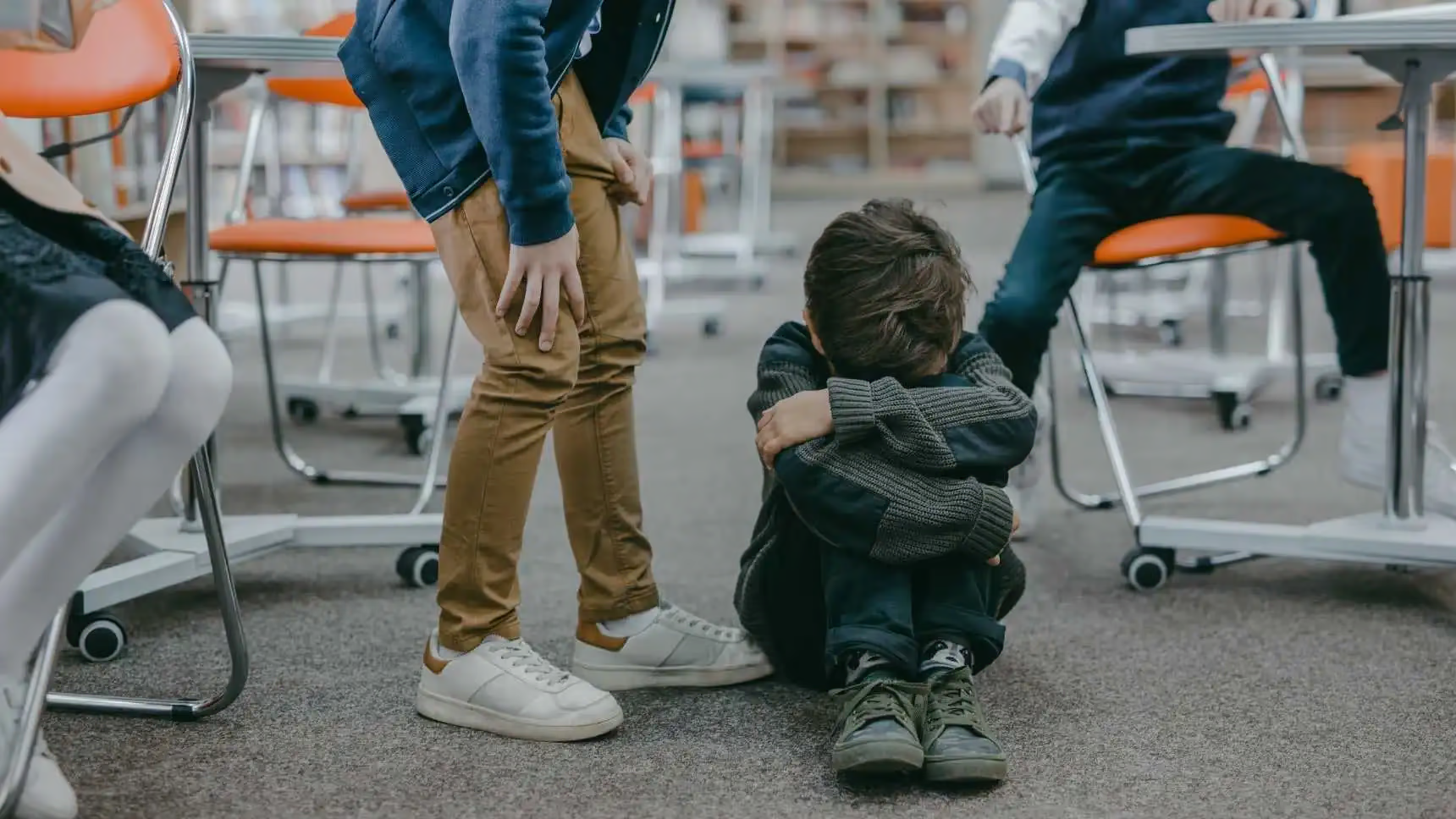
IMPORTANT: This article was prepared based on the Andalusian protocol for addressing cases of school bullying, as set forth in the Order of June 20, 2011. However, educational regulations and guidelines for action may have been subject to subsequent modifications, supplementary instructions, or updates, particularly regarding cyberbullying. When addressing a specific case, it is recommended to consult the current regulations of the relevant autonomous community and seek specialized legal advice.
School Bullying: Definition and Characteristics
Bullying is a form of psychological, verbal, or physical abuse directed at a student, carried out repeatedly over time by one or more classmates.
For a situation to be considered bullying, several factors must typically be present to distinguish it from an isolated conflict between students.
- Intent: The behavior is intended to cause harm, humiliate, exclude, or intimidate.
- To reiterate: this is not an isolated incident, but rather a pattern of behavior.
- Power imbalance: There is a situation of physical, psychological, social, or group superiority.
- Helplessness: The victim has difficulty defending themselves or putting an end to the situation.
- Collective or group component: In many cases, several students or a group are involved in reinforcing the behavior.
- Passive observers: Other colleagues are aware of the situation but do not intervene or report it.
Signs of Bullying
Bullying can take many forms. It does not always involve direct physical aggression; in many cases, it takes the form of exclusion, humiliation, intimidation, or online behavior.
- Social exclusion and marginalization.
- Verbal abuse, insults, or repeated taunts.
- Harassment, humiliation, or public ridicule.
- Direct or indirect physical assault.
- Intimidation, threats, or blackmail.
- Cyberbullying via social media, websites, email, or text messages.
- Distribution of images, insults, threats, or unwanted content.
- Harassment or assault related to sexual orientation or gender identity.
- Sexual harassment or sexual abuse.
Protocol for Addressing School Bullying in Andalusia
The autonomous communities, in exercising their authority over education, have adopted protocols for addressing school bullying. In Andalusia, the protocol is implemented within the framework of regulations governing coexistence in schools and establishes a series of steps aimed at detecting, reporting, investigating, and implementing protective measures.
Step 1. Identification and communication of the situation
Any member of the school community who is aware of or suspects a case of harassment should report it to a teacher, homeroom teacher, guidance counselor, or a member of the school administration. In any case, the information must be reported to the school principal or, in the principal’s absence, to a member of the school administration.
Step 2. Immediate actions
Upon receiving the report, the administrative team must meet with the affected student’s homeroom teacher and the guidance counselor to gather information, analyze it, and assess the necessary intervention. If a possible case of bullying is identified, the Provincial Education Inspection Service must be notified.
Step 3. Emergency measures
If necessary, the school must take urgent measures to protect the affected student and prevent further attacks.
- Measures to ensure the immediate safety of the person being harassed.
- Specific support and assistance for the affected student.
- Precautionary measures aimed at students suspected of bullying.
Step 4. Transfer to families or legal guardians
The homeroom teacher, the guidance counselor, or the school administration must inform the families or legal guardians of the students involved, with due discretion and confidentiality, explaining the situation and the measures taken.
Step 5. Notifying the other professionals
The school administration, while respecting the confidentiality and privacy of the minors, may inform the teaching staff and, if it deems it necessary, other school professionals or external social, health, or judicial authorities.
Step 6. Gathering Information
Once the urgent measures have been implemented, the management team must gather information from various sources to properly assess the situation.
- Review of existing documentation regarding the affected students.
- Observation of indicators in common areas, classrooms, and extracurricular activities.
- Interviews with students, classmates, families, guidance counselors, or other professionals.
- Preparation of a report by the school administration based on the information gathered.
During this phase, it is essential to ensure the protection of minors, the preservation of their privacy, immediate action, the creation of a climate of trust, the collection of evidence and indicators, and the avoidance of duplicate interventions or unnecessary delays.
Step 7. Application of corrections and disciplinary measures
Once the information has been verified, the school administration must take the appropriate corrective or disciplinary actions in accordance with the school’s code of conduct and applicable regulations.
Step 8. Communication to the coexistence commission
The school administration must forward the report and, if applicable, the disciplinary measures taken to the school’s student conduct committee.
Step 9. Communication to the educational inspection
The administration must submit the report to the Provincial Education Inspection Service, without prejudice to any immediate notification required under the protocol.
Step 10. Defining Measures and Actions
The administrative team, with guidance from educational counselors, must define measures and actions tailored to the specific case. These measures may be directed at the school and the classroom, as well as at the affected students, the students who committed the aggression, bystanders, families, and teachers.
- For the victim of harassment: protective measures, emotional support, social services, communication skills, self-esteem, and possible referral to specialized services.
- For students who exhibit aggressive behavior: corrective measures, educational interventions, behavior modification programs, and, if appropriate, referral to the appropriate services.
- With the observers: activities focused on empathy, awareness-raising, mediation, and peer support.
- With families: information, guidance, coordination, and commitments to harmonious coexistence.
- With the school’s faculty and staff: guidelines for intervention, follow-up, identification of indicators, and specific training.
The school administration must take responsibility for monitoring the measures adopted, providing regular updates to the student life committee, families, and the education inspectorate.
Step 11. Notifying Families
The families or legal guardians of the students involved must be informed of the proposed individual, organizational, and preventive measures, while always maintaining the confidentiality of the case.
Step 12. Follow-up by the education inspectorate
The education inspectorate must monitor the measures and actions that have been defined, as well as the academic progress of the students involved.
Preguntas frecuentes sobre acoso escolar y protocolo de actuación en Andalucía
¿Qué se considera acoso escolar?
Se considera acoso escolar una conducta de maltrato físico, verbal, psicológico, social o digital ejercida de forma reiterada contra un alumno o alumna, normalmente con intención de dañar y aprovechando una situación de desequilibrio o indefensión.
¿Cómo se diferencia el acoso escolar de un conflicto puntual?
El acoso escolar suele implicar repetición, intención de causar daño, desequilibrio de poder e indefensión de la víctima. Un conflicto puntual, aunque pueda ser grave, no siempre reúne esos elementos.
¿Qué formas puede adoptar el acoso escolar?
Puede manifestarse mediante insultos, burlas, amenazas, agresiones físicas, exclusión social, humillaciones, chantaje, difusión de imágenes, ciberacoso, acoso sexual o conductas vinculadas a la orientación sexual o identidad de la víctima.
¿Quién debe comunicar una posible situación de acoso?
Cualquier miembro de la comunidad educativa que conozca o sospeche una situación de acoso debe comunicarlo al profesorado, tutoría, orientación o equipo directivo, para que la información llegue a la dirección del centro.
¿Qué debe hacer el centro cuando recibe una comunicación de acoso?
El equipo directivo debe activar las actuaciones iniciales, recabar información, valorar la situación con tutoría y orientación y, si aprecia indicios de acoso, informar a la inspección educativa y adoptar medidas de protección.
¿Qué medidas urgentes pueden adoptarse para proteger a la víctima?
El centro puede adoptar medidas de seguridad, apoyo emocional, vigilancia, separación preventiva, acompañamiento, medidas cautelares respecto del alumnado presuntamente agresor y cualquier actuación necesaria para evitar nuevas agresiones.
¿Deben informarse las familias del alumnado implicado?
Sí. Las familias o responsables legales deben ser informados con cautela, confidencialidad y respeto a la intimidad de los menores, tanto de la situación detectada como de las medidas adoptadas o propuestas.
¿Qué información debe recopilar el centro durante el protocolo?
Debe revisar documentación, observar al alumnado en distintos espacios, entrevistar a personas implicadas o testigos, consultar a tutoría y orientación y elaborar un informe con los hechos, indicadores y medidas adoptadas.
¿Puede haber medidas disciplinarias frente al alumnado acosador?
Sí. Si se confirma la situación, la dirección del centro puede aplicar correcciones o medidas disciplinarias conforme al plan de convivencia y a la normativa educativa aplicable.
¿Cuándo conviene acudir a un abogado en un caso de acoso escolar?
Conviene acudir cuando el centro no actúa, las medidas son insuficientes, existen daños psicológicos o físicos, se produce ciberacoso, hay indicios de delito o la familia necesita asesoramiento para formular reclamaciones, denuncias o exigir responsabilidades.
Lawyers Specializing in Juvenile Cases | IN DIEM: Málaga, Seville, Madrid, Las Palmas de Gran Canaria, Almería, Huelva…
Cases of bullying require swift, prudent, and well-documented action. Protecting the child, communicating with the school, activating the protocol, and preserving evidence can be crucial to preventing the situation from escalating.
IN DIEM Abogados advises families, minors, and schools on cases of bullying, cyberbullying, conflicts in educational settings, and any potential administrative, civil, or criminal liabilities arising from these incidents.
Did you know that Abogados IN DIEM offers online and expedited services?
We offer our clients the option of receiving assistance via video call or videoconference, as well as by phone, depending on their preference, so that the assistance is as personalized as possible, provided immediately, and without the need to travel. This service is complemented by communication via email, which facilitates the review and delivery of documentation.
In addition, for businesses and individuals, IN DIEM Abogados offers urgent services and 24-hour support for matters that require a quick response.
Anything else about IN DIEM Lawyers? Here’s a short presentation video…
To acknowledge some of you, here’s this link.
You can find us in Seville, Madrid, Las Palmas de Gran Canaria, Málaga, Huelva, Punta Umbría, Tomares, Coria del Río, Dos Hermanas, Mairena del Alcor, Estepona, Marbella, and Mairena del Aljarafe. We look forward to serving you.