



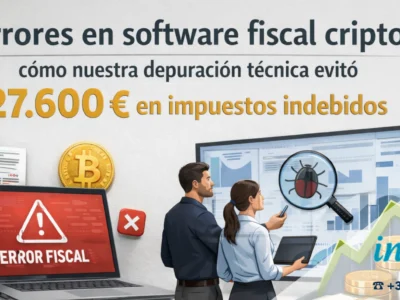
Errors in Crypto Tax Software: How Our Technical Rectification Prevented €27,600 in Undue Taxes
An error in crypto tax software incorrectly reflected a fictitious holding of over 3 BTC. Thanks to prior technical rectification and blockchain analysis, the payment of €27,600 in undue taxes was avoided.

DAC7: What the Tax Agency Does with Received Data and How It Uses It in Inspections. What Do They Review and How to Defend Yourself?
The DAC7 Directive has significantly strengthened the Tax Agency's ability to control economic activity carried out through digital platforms. In this article, we analyze how the Tax Agency uses the data received, what automatic cross-checks it performs, which profiles present a higher risk of inspection, and how to anticipate these by means of proper tax planning and regularization.

DAC7 in Spain: what it is, who it affects, and how it impacts digital platforms and companies
DAC7 in Spain imposes new tax obligations on digital platforms and sellers. We analyse who it affects, what is reported to the Tax Agency, and how to comply.

Penalties, Non-Compliance, and Legal Defense Against DAC8
The DAC8 Directive has radically changed tax control over cryptocurrencies in Europe. This article analyzes the most frequent non-compliance issues, the applicable penalty regime, and the main legal defense strategies against actions by the Tax Agency.

How to Plan Inheritances and Successions with Cryptocurrencies and Digital Assets in Spain
Complete legal guide on cryptocurrency inheritance: access to wallets, custody of private keys, tax obligations in Inheritance Tax, valuation of crypto and NFTs, digital inheritance and succession planning. Everything testators and heirs need to know in a digital and decentralized environment.
Use of DAC8 Data by Tax Authorities: Inspections, Tax Risks, and Crypto Information Matching
The DAC8 Directive will allow the Tax Agency to access detailed information on cryptocurrency operations and perform automatic data matching to detect tax non-compliance. This article analyzes how this data is used, which profiles present a higher risk of inspection, and what actions the Tax Administration can initiate.

Common mistakes when declaring cryptocurrencies in Spain and how to avoid them
Declaring cryptocurrencies in Spain remains one of the tax processes that generates the most doubts among taxpayers. In this guide, we analyze the most common mistakes users make—from lack of traceability to confusion between forms 172, 173, and 721—and how to avoid them in 2025 to prevent Tax Agency penalties. A clear, practical, and updated explanation to correctly fulfill your tax obligations and protect your digital assets.

DAC8: Tax and Reporting Obligations for Investors, Crypto Companies, and Platforms in the European Union
The DAC8 Directive introduces a mandatory system for the automatic exchange of tax information on crypto-assets in the European Union. Investors, companies, and crypto platforms are now subject to new identification, registration, and reporting obligations that strengthen tax control and eliminate tax opacity.

Seizures and Freezes: Can the Spanish Tax Agency Freeze Your Crypto Wallets?
If you trade in cryptocurrencies, it is essential to know how far the Spanish Tax Agency can go. We explain when it can seize or freeze cryptoassets, what happens with wallets, and how to protect yourself legally.

DAC8: What it is, How it Affects Crypto-assets, and Why it Changes Tax Control in the EU
The DAC8 Directive represents a structural change in the tax control of crypto-assets within the European Union. Through the automatic exchange of information between tax administrations, the EU brings cryptocurrency operations to the same level of transparency as traditional financial instruments. This new regulation directly affects crypto-asset service providers and significantly impacts investors and companies operating with digital assets. Understanding its scope, implementation timeline, and practical implications is key to anticipating tax risks and adapting to an increasingly demanding regulatory environment.