
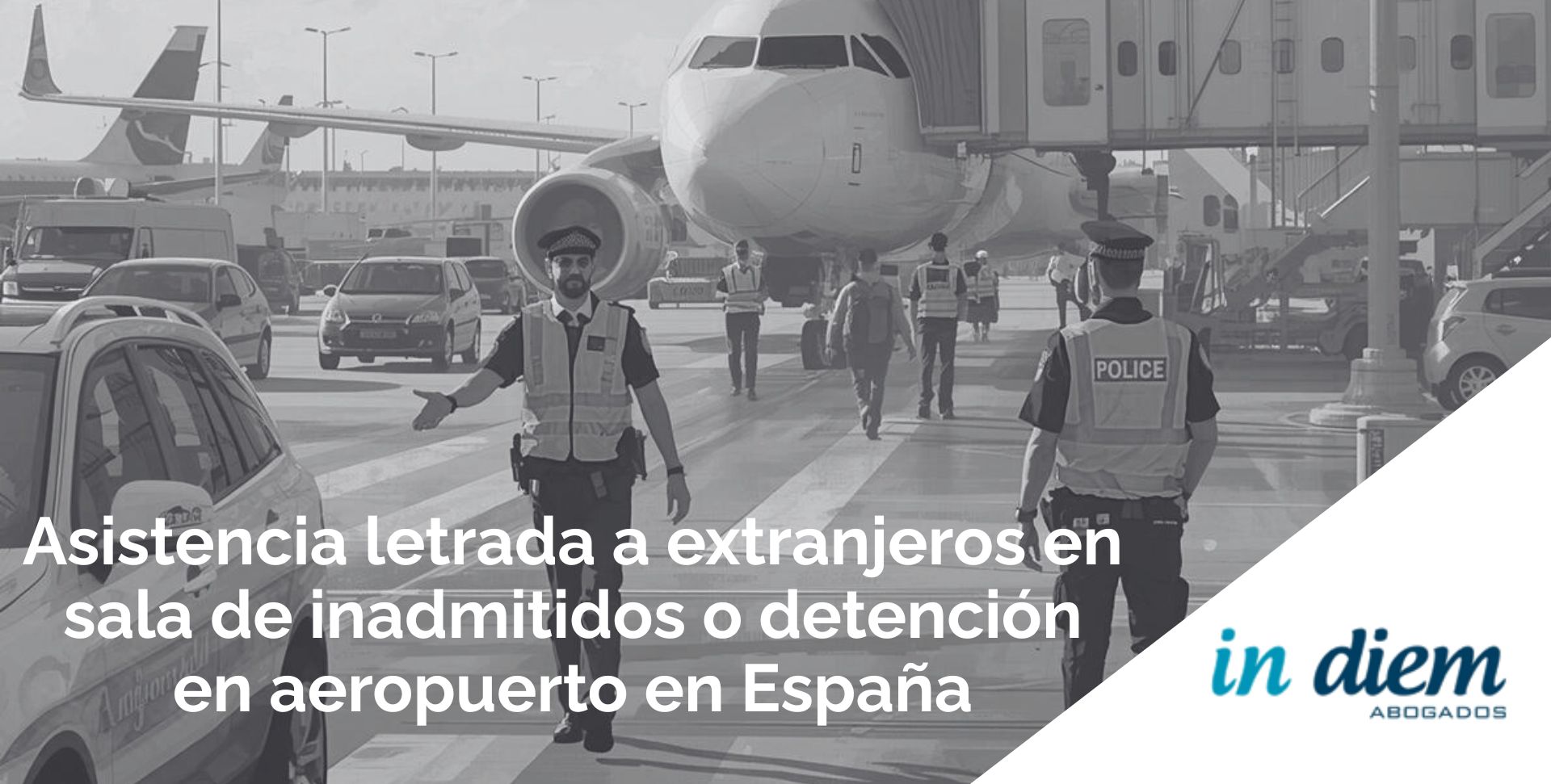
Legal Assistance for Foreigners in Airport Inadmissibility Rooms or Detention in Spain: Rights and Procedures
When a foreign national is held at a Spanish airport and taken to the so-called “inadmissibility room,” a critical situation begins that can determine their immediate future: either they eventually manage to enter Spain, or they will be returned to their country of origin within the next few hours.
At this delicate moment, having a lawyer specializing in airport immigration law is not a mere legal formality, but the real difference between having options and being defenseless.
This article explains what exactly happens during your stay in the inadmissibility room, what the administration is doing during that time, how the procedure actually works, and, above all, what a specialized lawyer can do to change the course of your situation.
What is the inadmissibility room and why are you taken there?
The inadmissibility room is a designated area in Spanish airports where individuals who have been denied entry into the country are held. Although you are physically in Spain, you have not legally entered yet. It is a kind of “neutral zone” where the National Police keep you while deciding what to do with you.
Why are you taken to this room? Common reasons
After passing passport control, agents may detect issues that prevent immediate entry, such as:
- Lack of adequate documentation
- Inconsistencies in the purpose of travel
- Alerts in police databases
- Doubts about financial means or accommodation
- Inability to prove compliance with legal requirements
The important thing to understand is that you are not being detained for committing a crime. This is an administrative procedure, not a criminal one. But even if it is not a police detention in the strict sense, your movements are completely restricted, and you cannot leave that area on your own.
How long can you stay in the inadmissibility room?
Here comes one of the most critical points: time is against you. Under normal conditions, you should only remain in the inadmissibility room for the strictly necessary time to arrange your return flight, which should ideally be a matter of hours.
However, the reality is that you can be there from a few hours to several days, depending on:
- The availability of flights to your country
- If there are problems identifying you or verifying your documentation
- If your case presents any special complexity
- If your lawyer is managing to halt the return while presenting arguments
According to European and Spanish regulations, if your stay in the inadmissibility room extends beyond 72 hours, the authorities must consider different measures, such as transferring you to a Foreigners Internment Center (CIE), which requires judicial authorization.
Difference between being in an inadmissibility room and formal detention
Many people confuse these concepts, but it is important to distinguish them because they determine your rights and the guarantees that protect you.
Stay in an inadmissibility room (most common situation)
This is what happens in most cases. You are under police control, in a restricted area of the airport, while your denial of entry is processed and your return is arranged. Technically, it is not a “deprivation of liberty” in the strict legal sense, although in practice your freedom of movement is totally limited.
This situation is considered a precautionary administrative measure and, in principle, does not require judicial authorization if it is brief.
Formal administrative detention
In more complex cases, the situation can lead to formal detention. This happens when:
- No flight is available to return you within a reasonable period
- Your identity cannot be verified, and you have no documentation
- There are judicial orders or police alerts against you
- There is suspicion that you have committed a crime
When this occurs, you are generally transferred to a Foreigners Internment Center (CIE), and in that case, a judge must expressly authorize your internment. You have the right to appear before the judge, accompanied by your lawyer, who will verify if your detention is legal and proportionate.
The key difference is this: in the inadmissibility room, the decision is purely administrative; if you are taken to a CIE, judicial control comes into play.
What is happening while you are in the inadmissibility room?
While you remain in that room, the administrative machinery is at work. It is important that you understand what the authorities are doing during that time, as this will help you better understand how your lawyer can intervene.
Phases of the administrative procedure
- First phase – Already completed: The detection of the problem at passport control and your transfer to the second line for a more in-depth interview. This phase has already occurred by the time you reach the inadmissibility room.
- Second phase – Detailed analysis: Specialized agents thoroughly review your case:
- They verify the authenticity of all your documents
- They consult national and international databases (including the Schengen Information System, shared by all countries in the Schengen area)
- They assess whether your explanations regarding the purpose of travel are credible
- They check if you have sufficient financial means for your stay
- They verify if you genuinely have accommodation
This phase can last several hours while they await responses from different computer systems and databases.
- Third phase – Formal decision: Once the analysis is complete, the instructing officer drafts a proposal for inadmission. A crucial moment occurs here: the hearing procedure.
Before issuing the final decision, they must give you the opportunity to respond to the proposal, provide additional documentation, or offer any explanations you deem necessary. This is a fundamental right, and although in practice it is sometimes done very quickly, this is the moment where your lawyer can make a difference.
- Fourth phase – Written resolution: If they finally decide to deny you entry, they must provide you with a written resolution, in a language you understand, clearly explaining:
- Why your entry is being denied
- Which legal norm they are applying
- What you can do if you disagree (i.e., how to appeal)
This resolution is a crucial document. Your lawyer needs it to know exactly what you are fighting against.
- Fifth phase – Organizing the return: In parallel, the authorities are coordinating your return flight with the airline. According to international aviation rules, the airline that brought you has the obligation to take you back if you are not allowed to enter.
Why is the procedure so fast?
From the notification of inadmission to boarding, only 6 to 12 hours may pass. The authorities want to resolve your situation as soon as possible for several reasons:
- To prevent you from remaining in uncomfortable conditions for too long
- To avoid overwhelming the inadmissibility room with many cases
- Because there is pressure to effectively control irregular immigration
- Because prolonging your stay incurs administrative costs
Once the flight takes off, reversing the situation is practically impossible. Therefore, the lawyer’s action must be immediate.
Your rights during your stay in the inadmissibility room
You already know your fundamental rights from the moment of retention. If you want to know more, read our article on:
Now let’s delve into how they specifically apply during your stay in the inadmissibility room and what you can demand at all times.
1. The right to legal assistance: your most important shield
From the very first minute you enter the inadmissibility room, you can demand that a lawyer be notified. This is not a right granted if there is time or if the authorities deem it convenient: it is a right you always have, without exception.
You can choose between:
Public defender
- Free of charge
- May take time to arrive
- Not always specialized in airport procedures
Specialized private lawyer
- Immediate intervention
- Knowledge of the airport environment
- Experience in similar cases
- Ability to act quickly and effectively
Specialization in airport immigration is critical. A good generalist lawyer may not know how to navigate an airport, which contacts to activate, what documentation to urgently request, or how to negotiate with border authorities. In contrast, a lawyer who does this regularly enters the airport knowing exactly what to do and how to do it quickly.
2. Right to understand what is happening: the interpreter
If you do not speak Spanish fluently, you have an absolute right to a free interpreter. This is not negotiable or optional.
The interpreter must be present:
- When they explain why your entry is being denied
- When they read you the inadmission resolution
- When your lawyer speaks with you to understand your case
- In any relevant communication with the authorities
Never, under any circumstances, sign a document you do not fully understand. Even if agents tell you it’s “just a form” or “it’s normal,” if you don’t 100% understand what you’re signing, demand an interpreter.
Many people have signed without understanding that they were voluntarily accepting their return or waiving the right to present arguments. Once you sign, it is very difficult to backtrack.
3. Right to communicate with the outside world
You have the right to communicate with:
Your family or friends: You can make phone calls to inform them of your situation. They will usually provide you with a phone to make these calls, although conversations may be monitored.
This communication is vital because your family can:
- Urgently find and hire a specialized lawyer
- Obtain documentation you need (bank confirmations, hotel reservations, company letters, etc.)
- Contact your consulate
- Find witnesses or evidence to prove that you meet the entry requirements
Your consulate: You have the right to have your country’s consular representation informed of what is happening to you. The consulate can:
- Advise you on your rights according to agreements between your country and Spain
- Help you obtain documentation if you have lost your passport or need a certificate
- In some cases, make diplomatic arrangements with the Spanish authorities
It is important to be realistic: your consulate cannot force Spain to let you in, but it can assist you, and in certain situations, its intervention can be useful.
4. Written information: the document that changes everything
The inadmission resolution must be delivered in writing, in a language you understand. This document must explain:
- Exactly why you are not being allowed to enter
- Which law or regulation is being applied
- What you can do if you disagree
This document is fundamental because:
- It is official proof of what is being done to you
- Your lawyer needs it to analyze whether the decision is correct or contains errors
- Without it, you cannot effectively appeal
- It marks the start of deadlines for filing appeals
Guard this document like gold. Do not lose it, do not damage it. Take photos with your mobile if allowed. Your legal future may depend on having this resolution well preserved.
5. Dignified conditions during your stay
Although you are being held, you are not a criminal and you have the right to:
- A place to rest with minimum hygiene conditions
- Access to restrooms
- Water and food
- Medical assistance if you feel unwell
- Respectful treatment from agents
If you believe you are being treated undignifiedly or that your conditions of stay are inhumane, tell your lawyer immediately. These situations can be reported to the Ombudsman and may constitute serious infractions by the administration.
What does your lawyer actually do at the airport?
Let’s be very clear about what a good specialized lawyer can do for you in these critical hours. It’s not just accompanying you or patting you on the back. Their work is technical, strategic, and, when done well, can completely change the outcome.
✔ First action: quick but exhaustive analysis of your case
When your lawyer arrives at the airport and speaks with you, they need to quickly understand:
- What the agents told you exactly
- What documentation you carried and what you showed them
- What you answered in the interviews
- What reasons they gave you for denying entry
- What additional documentation you could obtain
With this information and after reading the inadmission resolution (if already provided), the lawyer makes a quick legal diagnosis:
Does the denial make legal sense, or are there arguments to refute it? Are there procedural errors that could invalidate the decision? What additional documentation could change the situation? How much time do we have before you are put on the plane?
✔ Second action: direct communication with police officials
This is one of the most tangible advantages of having a specialized lawyer who knows the airport environment. An experienced lawyer in these cases has direct access to the heads of service of the Airport Immigration Brigade.
While you are held in the room unable to do anything, your lawyer:
- Speaks with the instructing officer of your case
- Obtains precise information about what exactly concerns them about your situation
- Professionally explains the arguments in your favor
- Formally presents additional documentation
- Negotiates possible solutions
This direct communication, professional-to-professional, is infinitely more effective than attempts by your family or friends to call or show up at the airport without legal knowledge.
Police officers are more willing to listen and reconsider their decision when the person speaking to them is a lawyer who knows the law, speaks in correct legal terms, and has professional credibility.
✔ Third action: obtaining and presenting urgent documentation
In many cases, inadmission occurs because you could not prove something at the time: that you have sufficient money, that you have accommodation, that your trip is legitimate, etc.
Your lawyer coordinates with your family, your bank, hotels, companies, or whoever is necessary to urgently obtain the documentation that can change the situation:
- Updated bank certifications demonstrating your financial resources
- Confirmations of hotel reservations with all formal requirements
- Invitation letters correctly processed with the Police
- Employment contracts or documents justifying the real purpose of your trip
- Return tickets proving your intention to return
The lawyer knows exactly what documents you need, how they should be drafted, what stamps or signatures they should bear, and how to present them to the authorities for evaluation.
This urgent document management can be the difference between being returned or finally being authorized entry.
✔ Fourth action: presenting technical arguments
If the inadmission resolution has already been issued, your lawyer can submit a written statement of arguments addressed to the superior official (usually the Head of the Provincial Immigration and Borders Brigade).
These arguments are a technical-legal document where the lawyer argues:
- Why the inadmission is legally incorrect
- What additional documentation proves that you meet the requirements
- What errors occurred in the procedure
- Why you should be allowed to enter
If the arguments are well-founded and presented on time, they can lead the authority to reconsider and revoke the inadmission before you are put on the plane.
✔ Fifth action: protecting your rights at all times
Your lawyer is there to ensure that:
- You are not pressured to sign anything you don’t understand
- All legal procedures are respected (hearing, correct notification, deadline for arguments)
- You have an interpreter if you need one
- The conditions of your detention are dignified
- Your fundamental rights are not violated
Their mere presence at the airport has an effect: the authorities know that a professional is monitoring that everything is done according to the law, and this significantly reduces the risk of irregularities.
✔ Sixth action: coordination with your consulate when useful
In certain cases, your lawyer coordinates with your consular representation to:
- Verify your identity if there are problems with your documentation
- Obtain documents from your country that may be relevant
- In exceptional situations, request that the consulate make diplomatic arrangements with the Spanish authorities
The lawyer knows when consular intervention can help and when it cannot, avoiding wasting time on procedures that will not contribute anything.
Why is the lawyer’s specialization crucial?
Here’s a point many people don’t understand until they experience it: not all lawyers can help you equally at an airport.
An airport case is not like other legal cases
- Speed is extreme: You don’t have days or weeks. You have hours, sometimes only 4-6 hours from notification to boarding.
- The environment is specific: The airport is not a courthouse or a normal police station. It has its own dynamics, its own officials, and its own ways of operating.
- The regulations are highly specialized: They mix Spanish law, European law (especially the Schengen Borders Code available in EUR-Lex), international treaties, and specific jurisprudence.
- Contacts are key: Knowing who to call, who to talk to, and how to present things at each airport makes a huge difference.
What a lawyer specializing in airport immigration provides
Real practical experience: They have handled dozens or hundreds of cases like yours. They know which arguments work with each type of inadmission, which documentation is truly decisive, and which tactics are effective.
Knowledge of the terrain: They personally know the police officials at the main Spanish airports. They know how shifts work, who makes decisions, and how to communicate effectively with them.
Network of contacts: They have collaborators in other countries to obtain urgent documentation, maintain relationships with consulates, know other specialized lawyers for complex cases, and know which institutions to turn to if necessary.
Capacity for immediate action: They can be at the airport in less than an hour. They know what to do as soon as they arrive. They don’t waste time on unnecessary things. They go straight to what can change your situation.
Constant updating: Immigration regulations change frequently. National Police instructions are updated. Jurisprudence evolves. A specialized lawyer stays abreast of all these changes.
What can happen if you hire a non-specialized lawyer
- They don’t know who to talk to or how to access the officials in charge
- They are unaware of what documentation is truly relevant in these cases
- They have no experience negotiating with airport authorities
- They may waste valuable time researching regulations that a specialist knows by heart
- They lack the network of contacts to obtain urgent documentation
The result is that, even with the best intentions, their effectiveness will be limited. And in a procedure where every hour counts, a lack of specialization can cost you entry to Spain.
Special situations requiring urgent attention
There are cases where vulnerability is greater, and the lawyer’s intervention must be even more intense and careful.
If you are a minor traveling alone
Unaccompanied foreign minors have reinforced special protection. If you are under 18 and arrive in Spain alone:
- They cannot return you without ensuring that someone will pick you up in your country and adequately care for you
- They must immediately notify child protection services
- You have the right to a legal representative who defends your interests
- The principle of the “best interests of the child” always applies, meaning any decision must prioritize your well-being
If they tell you that you are an adult but you maintain that you are a minor, they must conduct medical age determination tests, and during that process, you must be treated as a minor.
A lawyer specializing in these cases coordinates with the Juvenile Prosecutor’s Office and social services to ensure that you are not returned to a situation of helplessness.
If you fear returning to your country
If you come from a country where your life is in danger, where you are persecuted for political or religious reasons, for your sexual orientation, or where you have suffered violence, you have the right to request international protection (asylum).
When you state that you fear returning to your country, a different procedure is activated:
- They cannot return you immediately
- Your application must be assessed by the Asylum and Refugee Office
- You have the right to explain your situation in an interview
- The principle of “non-refoulement” is respected (they will not send you to a place where your life or freedom is in danger)
This is a very complex procedure that requires a lawyer with specific knowledge of asylum law and international refugee law.
If you have any medical condition or special vulnerability
Sick, disabled, pregnant, very elderly individuals, or those who have been victims of trafficking or violence require special attention.
Your lawyer must:
- Ensure you receive medical assistance if needed
- Verify that your detention conditions are appropriate for your situation
- Activate specific protection protocols if you are a victim of trafficking or gender violence
- Explore whether there is any humanitarian pathway that allows your entry despite not meeting all formal requirements
Legal framework protecting your rights
Even if you are in a vulnerable situation, you are not unprotected. There is a whole Spanish and European regulatory framework that sets limits on what can be done to you and guarantees that must be respected.
Fundamental European regulations
Schengen Borders Code: This is the European regulation that establishes the rules for border control throughout the Schengen area (which includes Spain and 26 other European countries). This code indicates:
- What requirements you must meet to enter
- What grounds allow your entry to be denied
- What guarantees you have during the procedure
- How inadmission must be notified
Spain must comply with these rules because they are directly applicable in all European Union countries.
Charter of Fundamental Rights of the EU: Recognizes rights such as human dignity, the prohibition of inhuman treatment, the right to effective judicial protection, and the right to good administration. All these rights also protect you at the airport.
Applicable Spanish regulations
Immigration Law (Organic Law 4/2000): This is the basic Spanish law on the rights and freedoms of foreign nationals (full text in the BOE). This law establishes your minimum rights, even if you are in an irregular situation.
Immigration Regulations: Details how the Immigration Law is applied, including border control, inadmission, and return procedures.
Law on Common Administrative Procedure: Establishes the rules that any public administration must follow when processing a procedure, including immigration procedures. If these rules are not complied with, the resolution may be annulled.
Control by authorities: who ensures compliance with rules
The judges: Although inadmission is an administrative decision by the Police (dependent on the Ministry of Interior), if you are formally deprived of liberty (transfer to a CIE), a judge must authorize it. You can also appeal to the courts later if you consider the decision was illegal.
The Ombudsman: This is an independent institution that oversees public administrations’ respect for people’s rights. The Ombudsman regularly visits inadmissibility rooms and Internment Centers, and publishes reports with recommendations to improve conditions and procedures.
If you believe your rights have been violated, you can file a complaint with the Ombudsman.
European and international bodies: Institutions such as the Court of Justice of the European Union, the European Court of Human Rights, and various human rights organizations monitor that countries comply with fundamental rights protection standards.
What to do and what not to do during your stay in the inadmissibility room?
WHAT YOU SHOULD DO:
✅ Stay calm: It’s very difficult, we understand, but getting nervous or aggressive will only make things worse. Authorities are more inclined to help you if you maintain a correct demeanor.
✅ Immediately call a specialized lawyer: Or ask your family to do so. It is the absolute priority. Every hour that passes without a lawyer is a lost hour.
✅ Cooperate with authorities: Answer their questions truthfully. Provide the documentation they request. If you behave cooperatively, they are more likely to be willing to reconsider their decision.
✅ Keep all documentation: Save all papers they give you. Take photos if you can. Your lawyer will need them.
✅ Contact your consulate: Notify your consular representation of what is happening to you.
✅ Clearly explain your situation: When speaking with your lawyer, tell them everything in detail: what they asked you, what you answered, what documents you have, what reasons they gave you for not letting you in.
WHAT YOU SHOULD NOT DO:
❌ Do not sign anything without 100% understanding it: Even if they pressure you. Even if they tell you it’s “routine.” If you don’t perfectly understand what you’re signing, demand an interpreter or wait for your lawyer to arrive.
❌ Do not give contradictory information: If you change your version of events, the authorities will suspect you are lying, and that will ruin your chances. Be consistent in everything you say.
❌ Do not lie: Lies always get discovered, and then you will lose all credibility. It is better to acknowledge a problem and seek a legal solution than to invent stories.
❌ Do not argue aggressively with agents: However frustrated you are, confronting the police rudely will not get you in. On the contrary, it may make them less flexible.
❌ Do not waste time: Every minute counts. Don’t fall asleep waiting to see what happens. Activate all possible resources as soon as possible: lawyer, consulate, family seeking documentation.
SALA DE INADMITIDOS EN AEROPUERTOS
Derechos del extranjero y asistencia letrada inmediata
TUS DERECHOS FUNDAMENTALES
- • Abogado desde el primer momento
- • Intérprete gratuito si no hablas español
- • Comunicación con familiares y consulado
- • Resolución escrita y comprensible
- • Condiciones dignas y asistencia médica
QUÉ HACE TU ABOGADO EN EL AEROPUERTO
- ✔ Analiza rápidamente tu caso y la legalidad de la inadmisión
- ✔ Habla directamente con los responsables policiales
- ✔ Presenta documentación urgente y alegaciones
- ✔ Protege tus derechos y evita firmas indebidas
- ✔ Coordina con tu consulado si es necesario
NO COMETAS ESTOS ERRORES
- ✗ Firmar documentos sin entenderlos
- ✗ Dar versiones contradictorias
- ✗ Discutir con los agentes
- ✗ Esperar sin contactar abogado
Información general. No sustituye asesoramiento jurídico personalizado.
How can we help you at IN DIEM Abogados?
In situations of retention, inadmissibility, or detention of foreign nationals at Spanish airports, time is a decisive factor. Rapid and specialized legal action can make the difference between reversing the denial of entry or being returned to the country of origin with lasting administrative consequences.
At IN DIEM Abogados, we provide urgent legal assistance at airports to foreign nationals and their families, acting from the very first moment of the border procedure.
We can help you with:
- Immediate legal assistance at the airport, both in retentions and in inadmissibility or administrative detention procedures.
- Direct dialogue with the National Police at border controls and inadmitted persons’ rooms.
- Review of the legality of the procedure, checking that all your rights are respected (legal assistance, interpreter, communication, motivation of the resolution).
- Submission of urgent allegations and provision of documentation to try to reverse the denial of entry before the return.
- Filing of appeals and urgent actions, including habeas corpus when there are irregularities in the deprivation of liberty.
- Advice and coordination with family members and consulates, facilitating the rapid collection of documents and communication with the authorities.
- Legal defense after return, analyzing the administrative consequences of the inadmissibility and the possibilities for appeal or lifting of entry bans.
We have specific experience in immigration procedures at the border, which allows us to act with speed, legal judgment, and practical knowledge of how airport controls work in Spain.
If you or a family member are held at an airport or facing a denial of entry, it is fundamental to contact a specialized lawyer immediately.
Early action can prevent serious consequences and protect your right to enter Spain legally.
Contact us. We are here to help you.
Frequently Asked Questions
Can I have a lawyer if I am held or denied entry at the airport?
Yes. From the first moment you are held at the border or a denial of entry procedure is initiated, you have the right to legal assistance. You can request a public defender or appoint a private lawyer specializing in immigration and airport procedures. Early legal assistance is key to protecting your rights and assessing urgent remedies.
What can a lawyer do if I am in the inadmitted persons' room?
A lawyer can verify the legality of the procedure, review the inadmissibility resolution, provide additional documentation, submit immediate allegations, and communicate directly with the National Police. In certain cases, they can also activate urgent remedies such as habeas corpus or coordinate actions with the corresponding consulate.
How long can I be held at the airport?
The stay in the inadmitted persons’ room is usually limited to the time strictly necessary to resolve the inadmissibility and organize the return, normally between a few hours and a maximum of several days. If the situation leads to administrative detention, specific legal deadlines and additional guarantees are activated, including possible judicial intervention.
Can I appeal a denial of entry before being returned?
Yes, but the deadlines are extremely short. It is possible to submit allegations and, in certain cases, file administrative or judicial appeals urgently. Once the return is executed, the chances of reversing the situation are drastically reduced, so it is fundamental to act quickly.
What documentation can help reverse an inadmissibility at the border?
Documents such as an invitation letter, hotel reservations, return ticket, proven financial means, employment contract, academic enrollment, or proof of the reason for the trip can be decisive. A specialized lawyer will know which documentation is relevant and how to present it effectively to the border authority.
How can IN DIEM Abogados help you in a detention or inadmissibility at the airport?
At IN DIEM Abogados, we provide urgent legal assistance at airports for retentions, inadmissibilities, and administrative detentions of foreign nationals. We act from the first moment to protect your rights, intervene with the National Police, submit allegations, and assess all available legal avenues to avoid return or minimize its consequences.
We accompany you through each phase of the process.
Other publications on our blog that may interest you
Expert Immigration Lawyers: European Union, Latin America, Spain, and International Service.
IN DIEM Abogados has a team with experience in previous roles such as Judge, State Attorney, Public Prosecutor, or University Lecturer, which will provide you with peace of mind and confidence, as you will have the best team—competitive and highly prepared—to achieve your objectives and meet your needs.
Our firm provides comprehensive advice in all areas related to immigration, including:
Residence Permits and Visas: We advise individuals and companies on obtaining residence permits, whether for work, studies, family reunification, or non-lucrative residence. We ensure that all procedures are carried out in accordance with current regulations and efficiently.
Work Permits and Self-Employment Authorisations: We guide foreign nationals through the process of obtaining employed or self-employed work permits, both for EU citizens and non-EU citizens, providing the necessary support to ensure the legality of their work activity in Spain.
Spanish Nationality: We provide legal advice throughout the process of obtaining Spanish nationality, whether by residence, marriage, or other means, ensuring comprehensive support at every step.
Family Reunification: We manage the family reunification process, both for immediate family members of resident foreign nationals and for those who wish to reunite with their family in Spain, ensuring compliance with legal requirements.
Immigration and Expulsion: We defend the rights of foreign nationals against administrative decisions that may affect their situation in Spain, including appeals against permit refusals and expulsion proceedings.
Advice to Companies: We advise companies that need to manage the hiring of foreign staff or wish to establish subsidiaries in Spain, ensuring compliance with labour and immigration regulations.
We are at your disposal for anything you need. You can reach us via IN DIEM Lawyers Phone (+34) 916 353 892. For urgent cases, you can contact us on IN DIEM 24-Hour Emergency Lawyers Phone: (+34) 610 667 452.
Did you know that IN DIEM Abogados offers an online service and an urgent service?
We offer our clients the option of being assisted via video call or videoconference, as well as by telephone, according to our clients’ preference, so that the assistance is as personal as possible, with absolute immediacy, without the need to travel. This service is complemented by communication via email, which facilitates the analysis and delivery of documentation.
Likewise, we offer urgent and 24-hour services for our companies, handling national and international contracting operations.
For more information on the Online Legal Advisory Service HERE, the 24-hour and Urgent Service, HERE, and some recognitions, we leave you this link.


Anything else about IN DIEM Lawyers? Here’s a short presentation video…
Would you like to have an in-person meeting with us? You can find us in Madrid, Las Palmas de Gran Canaria, Tenerife, Málaga, Seville, Huelva, Tomares, Coria del Rio, Dos Hermanas, Mairena del Alcor, Estepona, Marbella, Mairena del Aljarafe… it will be a pleasure to assist you…!!


About Post Author