
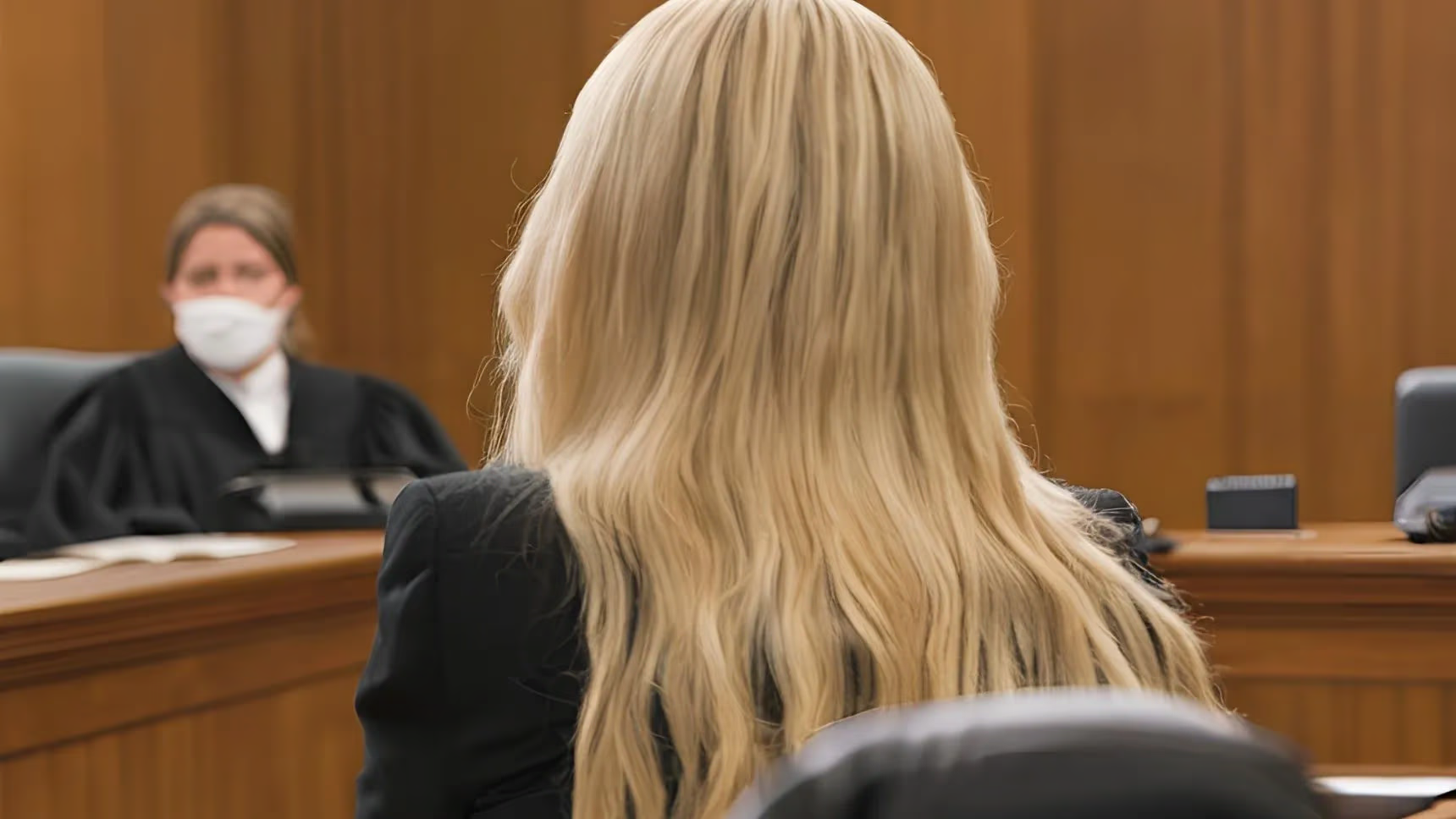
The case of Begoña Gómez Fernández has generated significant social and political repercussions in Spain due to accusations of influence peddling and facilitating public contracts worth 10 million euros to companies with which she had friendly relations, especially those associated with businessman Juan Carlos Barrabés. It is alleged that she used her position as the wife of Pedro Sánchez Pérez-Castejón, President of the Government of Spain, for these purposes. Gómez Fernández exercised her right not to testify on two occasions, while her lawyer asserts that she has nothing to hide.
This article analyzes the assessment of the accused’s silence or refusal to testify during the investigation and oral trial from a jurisprudential perspective, which is crucial for establishing an adequate defense strategy. A relevant example is Madrid Provincial Court Judgment no. 100/2014, of February 6, supported by various resolutions:
Constitutional Court Judgment No. 61/2005
It is logical and reasonable to deduce an indication of guilt from the passive conduct of the accused, but this deduction must be made within the context of a conviction formed by evaluating all available evidence.
Constitutional Court Judgment No. 202/2000
It is considered that, in the presence of certain objective evidence presented by the prosecution, the accused’s lack of explanations due to exercising the right to remain silent may be used by the judge to support a conviction. However, this conviction cannot be based solely on the fact that the accused chose to remain silent.
Supreme Court Criminal Chamber Judgment 21-10-2004
It is recognized that the accused’s silence in the oral trial, by refusing to testify, is a legitimate right and part of their right to defense, and therefore this silence cannot be considered as incriminating evidence. However, in cases where the prosecution has presented sufficient evidence requiring an explanation from the accused, their silence is not taken as evidence against them, but it can be considered an element when evaluating the evidence presented.
Judgments of the European Court of Human Rights dated February 8, 1996 (Murray v. United Kingdom), and March 20, 2001 (Telfner v. Austria)
It is considered that the Court may draw conclusions from the accused’s silence when, given the evidence presented by the prosecution, the only logical conclusion is that the accused has no explanation for the case. The Supreme Court, for its part, has affirmed that the assessment of the accused’s silence must be complementary, acting as a final argument on the existence of incriminating evidence. That is, there must always be other evidence that proves the fact and the accused’s involvement.
Ultimately, the Judgment and the support of these resolutions indicate that the accused’s silence will never be incriminating evidence or a rational indication of criminality, as it constitutes a fundamental right recognized in Art. 24.2 of the Spanish Constitution.
However, the court may assess silence when evaluating incriminating evidence not refuted by the accused, suggesting that silence can be interpreted as a certain acceptance of the prosecution’s thesis and its evidence by not offering a contradiction or alternative explanation.
Author: Antonio Mamo Pérez
Preguntas frecuentes sobre el derecho a guardar silencio en el proceso penal
¿Tiene derecho un investigado o acusado a guardar silencio?
Sí. El derecho a guardar silencio forma parte del derecho de defensa reconocido en el artículo 24.2 de la Constitución Española. Ninguna persona investigada o acusada está obligada a declarar contra sí misma ni a confesarse culpable.
¿Guardar silencio puede considerarse una prueba de culpabilidad?
No. El silencio del investigado o acusado no puede ser considerado, por sí solo, una prueba de cargo ni un indicio suficiente de culpabilidad. Para condenar debe existir prueba válida, suficiente y obtenida con todas las garantías.
¿Puede el tribunal valorar el silencio del acusado?
Sí, pero con límites. La jurisprudencia admite que el silencio pueda valorarse de forma complementaria cuando existen pruebas de cargo relevantes que requerirían una explicación razonable. En ningún caso puede sustituir la necesidad de prueba suficiente.
¿Qué diferencia hay entre guardar silencio y admitir los hechos?
Guardar silencio no equivale a reconocer los hechos ni a aceptar la tesis de la acusación. Es una manifestación legítima del derecho de defensa. La culpabilidad debe probarse por la acusación, no deducirse automáticamente de la falta de declaración.
¿Puede una condena basarse únicamente en el silencio?
No. Una condena penal no puede fundarse exclusivamente en que el acusado haya decidido no declarar. Deben existir otras pruebas de cargo que acrediten los hechos y la participación de la persona acusada.
¿Qué ha dicho el Tribunal Constitucional sobre el silencio del acusado?
El Tribunal Constitucional ha señalado que el silencio puede ser valorado dentro del conjunto de la prueba, pero no puede operar como prueba autónoma de culpabilidad. Su valoración debe realizarse siempre con respeto al derecho de defensa y a la presunción de inocencia.
¿Qué criterio sigue el Tribunal Supremo?
El Tribunal Supremo ha admitido que el silencio pueda tener relevancia argumentativa cuando la acusación ha aportado pruebas sólidas que no reciben explicación alternativa. Aun así, exige que exista una base probatoria independiente y suficiente.
¿Qué importancia tiene la estrategia de defensa?
La decisión de declarar o guardar silencio debe formar parte de una estrategia de defensa individualizada. Deben valorarse las pruebas existentes, el momento procesal, los riesgos de contradicción y la conveniencia de ofrecer o no una explicación alternativa.
¿Es lo mismo guardar silencio en instrucción que en juicio oral?
No necesariamente. Aunque el derecho a guardar silencio existe en ambas fases, sus efectos estratégicos pueden ser distintos. La instrucción sirve para investigar los hechos, mientras que el juicio oral es el momento central de valoración de la prueba.
Expert Lawyers in different Areas of Law: Family, Immigration, Criminal, Administrative, Banking and Financial, Labor, Money Laundering, New Technologies and much more: Málaga, Marbella, Seville, Madrid, Las Palmas de Gran Canaria, Almería, Huelva…
In addition, Abogados IN DIEM has extensive experience and a high degree of specialization in various practice areas , offering individualized and personalized advice in all fields and sectors to both individuals and public and private companies.
Abogados IN DIEM has a team with experience in roles such as magistrate, state attorney, prosecutor, and university professor, which will give you peace of mind and confidence, knowing you have the best team—one that is competitive and highly qualified to achieve your goals and meet your needs.
We are at your disposal for whatever you need. You can reach us via IN DIEM Lawyers Phone (+34) 901 900 071 or (+34) 916 353 892 or by email at info@in-diem.com
Did you know that Abogados IN DIEM offers online and expedited services?
We offer our clients the option of receiving assistance via video call or videoconference, as well as by phone, depending on their preference, so that the assistance is as personalized as possible, provided immediately, and without the need to travel. This service is complemented by communication via email, which facilitates the review and submission of documentation.
We also offer urgent and 24-hour services to our companies, handling both domestic and international contracting operations.
Anything else about IN DIEM Lawyers? Here’s a short presentation video…
To acknowledge some of you, here’s this link.
You can find us in Seville, Madrid, Las Palmas de Gran Canaria, Málaga, Huelva, Punta Umbría, Tomares, Coria del Río, Dos Hermanas, Mairena del Alcor, Estepona, Marbella, and Mairena del Aljarafe. We look forward to serving you.