



Blog

Protected Assets: Tax Treatment

Assets and Rights of Persons with Disabilities 1. Protected Assets: What is it? In Spain, the concept of “Protected Assets” was introduced to offer a legal tool that allows for the proper safeguarding and management of the assets and rights of persons with disabilities, whether adults or minors with some limitation. The objective of this legal figure is to ensure that the resources allocated to these individuals are used exclusively to cover their vital needs and improve their quality of life, protecting them from possible squandering or improper use. Protected Assets are configured as a set of assets, rights, and obligations, specifically and exclusively intended for the care, well-being, and development of the beneficiary, in order to provide economic stability and long-term security. It can be constituted by a wide range of assets and rights, provided that their purpose is to meet the needs of the beneficiary. Among the assets...
Read More

Patrimonio Protegido: Tratamiento Fiscal

Bienes y Derechos de personas con discapacidad 1. Patrimonio Protegido: ¿Qué es? En España, el concepto de “Patrimonio Protegido” fue introducido para ofrecer una herramienta legal que permita salvaguardar y gestionar adecuadamente los bienes y derechos de personas con discapacidad, mayores de edad o menores de edad con alguna limitación. Esta figura jurídica tiene como objetivo garantizar que los recursos asignados a estas personas se utilicen exclusivamente para cubrir sus necesidades vitales y mejorar su calidad de vida, protegiéndolos de posibles dilapidaciones o usos indebidos. El Patrimonio Protegido se configura como un conjunto de bienes, derechos y obligaciones, que se destina de forma específica y exclusiva al cuidado, bienestar y desarrollo de la persona beneficiaria, a fin de proporcionar estabilidad económica y seguridad a largo plazo. Puede estar constituido por una amplia gama de bienes y derechos, siempre que su finalidad sea la de atender las necesidades del beneficiario Entre...
Read More

Is exercising the right to remain silent an indication of guilt?

The case of Begoña Gómez Fernández has generated significant social and political repercussions in Spain due to accusations of influence peddling and facilitating public contracts worth 10 million euros to companies with which she had friendly relations, especially those associated with businessman Juan Carlos Barrabés. It is alleged that she used her position as the wife of Pedro Sánchez Pérez-Castejón, President of the Government of Spain, for these purposes. Gómez Fernández exercised her right not to testify on two occasions, while her lawyer asserts that she has nothing to hide. This article analyzes the assessment of the accused’s silence or refusal to testify during the investigation and oral trial from a jurisprudential perspective, which is crucial for establishing an adequate defense strategy. A relevant example is Madrid Provincial Court Judgment no. 100/2014, of February 6, supported by various resolutions: Constitutional Court Judgment No. 61/2005 It is logical and reasonable to...
Read More

¿Es el ejercicio del Derecho a no declarar un indicio de culpabilidad?

El caso de Begoña Gómez Fernández ha generado una gran repercusión social y política en España debido a las acusaciones de tráfico de influencias y facilitación de contratos públicos por valor de 10 millones de euros a empresas con las que tenía relaciones de amistad, especialmente las asociadas con el empresario Juan Carlos Barrabés. Se alega que utilizó su posición como esposa de Pedro Sánchez Pérez-Castejón, Presidente del Gobierno de España, para estos fines. Gómez Fernández se acogió a su derecho a no declarar hasta en dos ocasiones, mientras su abogado asegura que ella no tiene nada que ocultar. Este artículo analiza la valoración del silencio del acusado o su negativa a declarar durante la instrucción y el juicio oral desde un punto de vista jurisprudencial, lo cual es crucial para establecer una estrategia de defensa adecuada. Un ejemplo relevante es la Sentencia de la Audiencia Provincial de Madrid núm....
Read More

Are People with Autism Still Victims of Workplace Harassment? Real Case—Healthcare Center

Workplace harassment, also known as “mobbing“, is a concerning phenomenon affecting numerous workers in Spain. It consists of a series of hostile and humiliating behaviors that occur systematically and recurrently in the work environment, causing physical and emotional harm to victims. As the world of work evolves, organizational structures and power dynamics can give rise to situations where workplace harassment becomes a critical problem for employee well-being and company productivity. Workplace harassment is punishable by law, as stated in Article 173.1 of the Criminal Code: “Anyone who inflicts degrading treatment on another person, seriously undermining their moral integrity, shall be punished with imprisonment of six months to two years. The same penalty shall be imposed on those who, having knowledge of the whereabouts of a person’s corpse, repeatedly conceal such information from the family members or relatives of that person. The same penalty shall apply to those who, within the...
Read More

¿Las personas con Autismo siguen siendo victimas de acoso laboral? Caso Real-Centro de Salud

El acoso laboral, también conocido como “mobbing“, es un fenómeno preocupante que afecta a numerosos trabajadores en España. Consiste en una serie de comportamientos hostiles y humillantes que se producen de manera sistemática y recurrente en el entorno laboral, causando daños físicos y emocionales en las víctimas. A medida que el mundo del trabajo evoluciona, las estructuras organizativas y las dinámicas de poder pueden dar lugar a situaciones donde el acoso laboral se convierte en un problema crítico para el bienestar de los empleados y la productividad de las empresas. El acoso laboral se encuentra penado, así aparece en el artículo 173.1 del Código penal: “El que infligiera a otra persona un trato degradante, menoscabando gravemente su integridad moral, será castigado con la pena de prisión de seis meses a dos años. Igual pena se impondrá a quienes, teniendo conocimiento del paradero del cadáver de una persona, oculten de modo...
Read More

Use of video games for money laundering. Illicit activities.

The 21st century has immersed society in an unprecedented technological era, where video games are not just youth entertainment, but a universal phenomenon encompassing all ages. From our grandparents to our mothers, almost everyone owns a smartphone, a device that usually includes some type of pre-installed video game. This fact highlights digital penetration in daily life, a scenario where familiarity with new technologies is reflected in constant news coverage of technological advancements, negative experiences, and even major industry events and conventions. However, this extensive knowledge has also opened doors for those seeking to exploit these platforms for illicit purposes. Specifically, we will focus on how video game sales platforms and online games have become tools for money laundering. To better understand this concept, we refer to Chapter XIV of the Spanish Penal Code, which describes money laundering as the process of concealing the illegitimate origin of goods or assets to...
Read More

Uso de videojuegos para el blanqueo de capitales. Actividades ilícitas.

El siglo XXI ha sumergido a la sociedad en una era tecnológica sin precedentes, donde los videojuegos no son solo un entretenimiento juvenil, sino un fenómeno universal que abarca a todas las edades. Desde nuestros abuelos hasta nuestras madres, casi todos poseen un smartphone, dispositivo que habitualmente incluye algún tipo de videojuego preinstalado. Este hecho resalta la penetración digital en la vida cotidiana, un escenario donde la familiaridad con las nuevas tecnologías se ve reflejada en la cobertura constante de noticias sobre avances tecnológicos, experiencias negativas e incluso grandes eventos y convenciones del sector. Sin embargo, este amplio conocimiento también ha abierto puertas a aquellos que buscan explotar estas plataformas para fines ilícitos. Específicamente, nos centraremos en cómo las plataformas de venta de videojuegos y juegos en línea se han convertido en herramientas para el blanqueo de capitales. Para entender mejor este concepto, acudimos al Capítulo XIV del Código Penal...
Read More

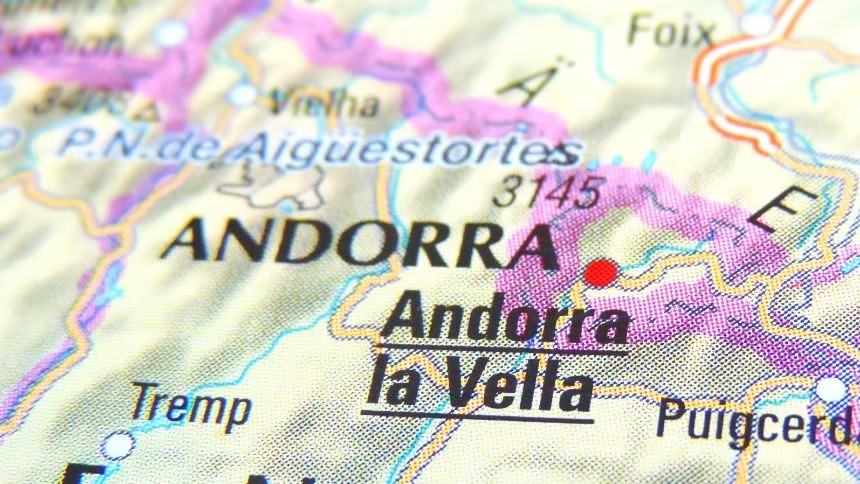
Incorporation of Companies in Andorra

Currently, we can observe—whether in the news or on social media (particularly in the world of content creators or high-level athletes)—a clear trend among companies or individuals to relocate to Andorra, seeking to invest capital or establish a company in that country. This is not only due to the clear tax advantages offered by the country (a maximum tax rate of 10 percent, unlike Spain where it can reach fifty percent), but also because, following the latest amendments to Andorra’s capital companies law and the entry into force of the foreign investment law, the procedures for establishing companies in Andorra have been greatly simplified, requiring not only less documentation but also eliminating requirements that, prior to the aforementioned amendments, were difficult to fulfill. In relation to the above, the significant growth of commercial companies in Andorra—particularly those from Spain—is due to the fact that their structure and regulations are very...
Read More

Creación de Sociedades en Andorra

Actualmente podemos observar ya sea en las noticias o en las redes sociales (Concretamente en el mundo relacionado con los creadores de contenido o deportistas de alto nivel) hay una clara tendencia de las empresas o individuos a trasladarse a Andorra, buscando invertir capital o crear una empresa en dicho país. Esto no solo se debe a las claras ventajas fiscales que ofrece el país (Un tipo impositivo máximo del 10 por ciento, a diferencia de España en donde puede llegar a ser del cincuenta por ciento), sino que a raíz de las últimas modificaciones realizadas a la ley de sociedades de capital de Andorra y la entrada en vigor de la ley de inversión extranjera, los trámites para crear empresas en Andorra se ha simplificado enormemente, debiendo no solo que presentar menos documentación sino eliminando requisitos que antes de las citadas modificaciones eran complicados de cumplir. En relación a...
Read More