
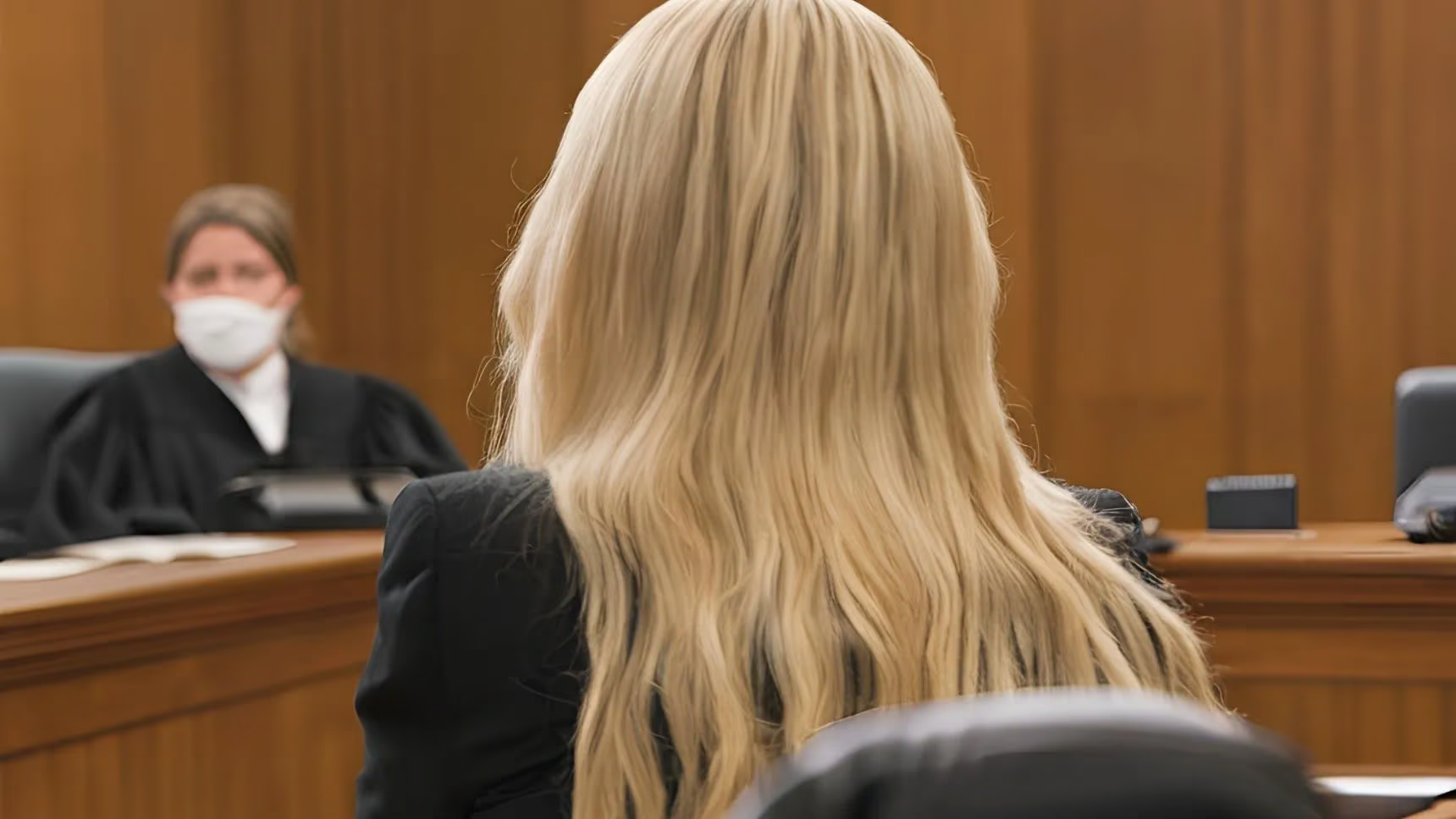
Is exercising the right to remain silent an indication of guilt?
The case of Begoña Gómez Fernández has generated significant social and political repercussions in Spain due to accusations of influence peddling and facilitating public contracts worth 10 million euros to companies with which she had friendly relations, especially those associated with businessman Juan Carlos Barrabés. It is alleged that she used her position as the wife of Pedro Sánchez Pérez-Castejón, President of the Government of Spain, for these purposes. Gómez Fernández exercised her right not to testify on two occasions, while her lawyer asserts that she has nothing to hide.
This article analyzes the assessment of the accused’s silence or refusal to testify during the investigation and oral trial from a jurisprudential perspective, which is crucial for establishing an adequate defense strategy. A relevant example is Madrid Provincial Court Judgment no. 100/2014, of February 6, supported by various resolutions:
Constitutional Court Judgment No. 61/2005
It is logical and reasonable to deduce an indication of guilt from the passive conduct of the accused, but this deduction must be made within the context of a conviction formed by evaluating all available evidence.
Constitutional Court Judgment No. 202/2000
It is considered that, in the presence of certain objective evidence presented by the prosecution, the accused’s lack of explanations due to exercising the right to remain silent may be used by the judge to support a conviction. However, this conviction cannot be based solely on the fact that the accused chose to remain silent.
Supreme Court Criminal Chamber Judgment 21-10-2004
It is recognized that the accused’s silence in the oral trial, by refusing to testify, is a legitimate right and part of their right to defense, and therefore this silence cannot be considered as incriminating evidence. However, in cases where the prosecution has presented sufficient evidence requiring an explanation from the accused, their silence is not taken as evidence against them, but it can be considered an element when evaluating the evidence presented.
And Judgments of the European Court of Human Rights of February 8, 1996 (Case Murray v. United Kingdom), and of March 20, 2001 (Case Telfner v. Austria)
It is considered that the Court may draw conclusions from the accused’s silence when, given the evidence presented by the prosecution, the only logical conclusion is that the accused has no explanation for the case. The Supreme Court, for its part, has affirmed that the assessment of the accused’s silence must be complementary, acting as a final argument on the existence of incriminating evidence. That is, there must always be other evidence that proves the fact and the accused’s involvement.
Ultimately, the Judgment and the support of these resolutions indicate that the accused’s silence will never be incriminating evidence or a rational indication of criminality, as it constitutes a fundamental right recognized in Art. 24.2 of the Spanish Constitution.
However, the court may assess silence when evaluating incriminating evidence not refuted by the accused, suggesting that silence can be interpreted as a certain acceptance of the prosecution’s thesis and its evidence by not offering a contradiction or alternative explanation.
Author: Antonio Mamo Pérez
Expert Lawyers in different Areas of Law: Family, Immigration, Criminal, Administrative, Banking and Financial, Labor, Money Laundering, New Technologies and much more: Málaga, Marbella, Seville, Madrid, Las Palmas de Gran Canaria, Almería, Huelva…
Furthermore, IN DIEM Lawyers has extensive experience and a high degree of specialization in various Practice Areas, offering individual and personalized advice in all fields and sectors to both individuals and public and private companies.
IN DIEM Abogados has a team with experience in previous roles such as Judge, State Attorney, Public Prosecutor, or University Lecturer, which will provide you with peace of mind and confidence, as you will have the best team—competitive and highly prepared—to achieve your objectives and meet your needs.
We are at your disposal for anything you may need. You can reach us via the IN DIEM Attorneys telephone line at (+34) 901 900 071 or (+34) 916 353 892, or by email at the following address: info@in-diem.com
Did you know that IN DIEM Abogados offers an online service and an urgent service?
We offer our clients the option of being assisted via video call or videoconference, as well as by telephone, according to our clients’ preference, so that the assistance is as personal as possible, with absolute immediacy, without the need to travel. This service is complemented by communication via email, which facilitates the analysis and delivery of documentation.
Likewise, we have urgent and 24-hour services available for our companies, handling national and international contracting operations.
For more information on the Online Legal Advisory Service HERE, and for the 24-Hour and Urgent Service, HERE.
We guarantee the best possible outcome, whatever your case.
- Personalized and professional service
- Assistance throughout the entire judicial process
- 24-hour contact with your expert criminal lawyer
- Absolute confidentiality


Would you like to know more about IN DIEM Abogados? Here is this short introductory video…
You will find us in Seville, Madrid, Las Palmas de Gran Canaria, Málaga, Tomares, Coria del Río, Dos Hermanas, Mairena del Alcor, Estepona, Marbella, Mairena del Aljarafe… it will be a pleasure to assist you…!!


About Post Author